 EN
EN

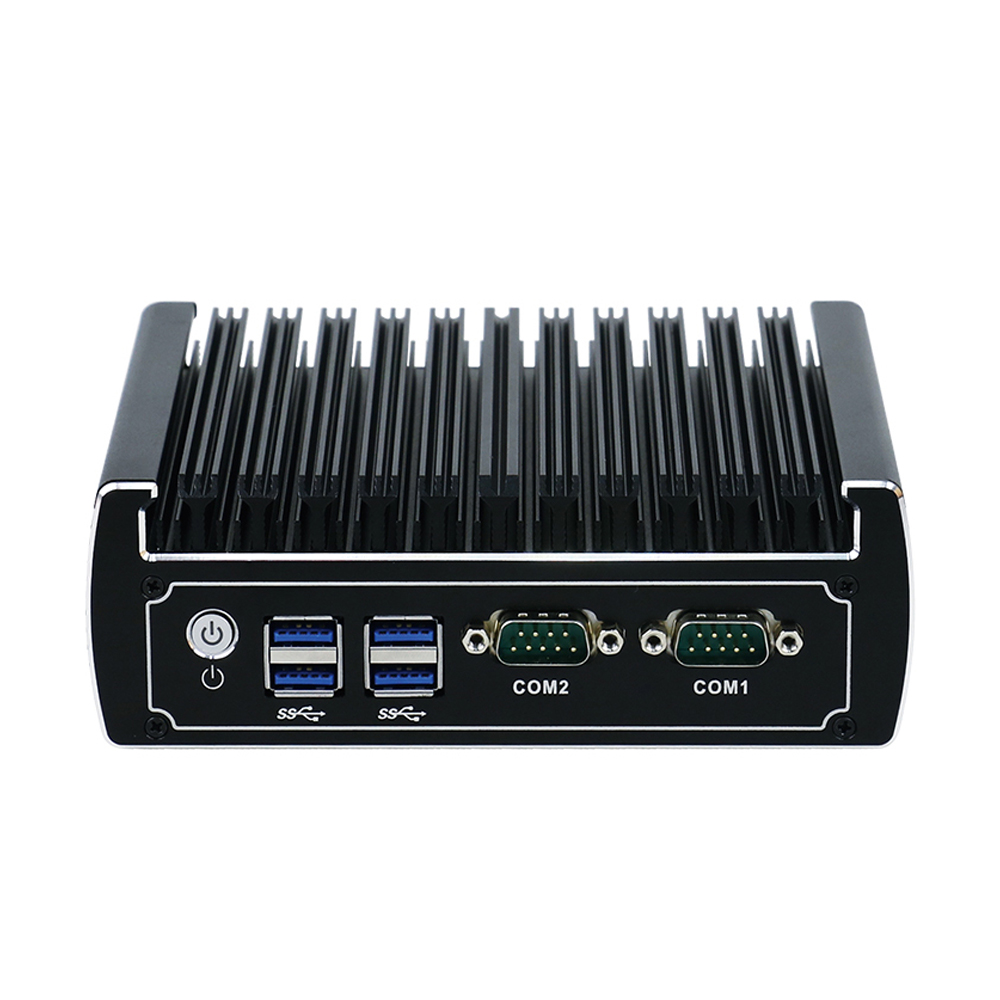
Rugged Design and Environmental Resilience for Industrial Environments
Fanless Thermal Management and IP65/IP67 Dust/Water Resistance
Industrial mini PCs use fanless cooling with high-conductivity aluminum or copper alloys—eliminating failure-prone moving parts in dusty, corrosive environments. Thermal management studies (2024) show this design reduces maintenance needs by 40%. Paired with IP65/IP67-rated enclosures, these systems reliably block fine particulates and high-pressure water jets—essential in food processing plants and wastewater facilities, where contamination drives an average $740k in annual downtime (Ponemon 2023). Sealed, vent-free construction also prevents chemical ingress and ensures silent operation near noise-sensitive instrumentation.
Shock, Vibration, and Wide-Temperature Operation (-40°C to 85°C)
Built for extreme physical stress, industrial mini PCs withstand 50G shock impacts and operate continuously under 5Grms vibration—making them suitable for mounting on robotics, mobile mining equipment, or rail-mounted inspection systems. Their extended thermal range (–40°C to 85°C) removes dependency on HVAC in foundries, outdoor Arctic logistics hubs, or unconditioned control rooms. Stainless steel chassis and integrated vibration-dampening mounts mitigate mechanical fatigue, extending hardware service life by 3–5 years compared to commercial-grade units in continuous manufacturing use.
Edge Intelligence: AI Acceleration and Real-Time Industrial Computing
Industrial mini PCs now integrate purpose-built processors that execute AI workloads directly at the edge—enabling sub-millisecond inference for robotics guidance, real-time quality assurance, and adaptive process control without cloud dependency.
NVIDIA Jetson Orin vs. Intel Core + VPU for AI Inference in Robotics and Vision Systems
NVIDIA Jetson Orin modules deliver industry-leading AI throughput—up to 275 TOPS—ideal for multi-sensor fusion and complex defect detection in high-speed vision systems. Intel Core processors with integrated VPUs offer strong compatibility with legacy machine vision software and deterministic real-time OS support. The choice hinges on workload complexity and integration requirements:
| Feature | Jetson Orin | Intel Core + VPU |
|---|---|---|
| Peak AI Performance | 275 TOPS | 13 TOPS (VPU only) |
| Power Efficiency | 15–60W range | 35–65W range |
| Ideal Use Case | Multi-sensor AI robotics | Legacy system integration |
Native Support for OPC UA, MQTT, and TSN in Industrial Mini PCs
Seamless factory integration starts with native protocol support. Leading industrial mini PCs embed OPC UA for secure, platform-agnostic device communication; MQTT for lightweight, scalable IIoT telemetry; and Time-Sensitive Networking (TSN) for microsecond-precise, deterministic data delivery across distributed control systems. This eliminates external gateways, cutting integration latency by 40% (Industrial IoT Report 2024) and enabling synchronized motion control, predictive analytics, and closed-loop automation across production lines.
Application-Specific Deployment Across Key Industrial Verticals
Predictive Maintenance and HMI Integration Using ARM-Based Mini PCs
ARM-based mini PCs power responsive, low-latency predictive maintenance and HMI applications—processing vibration, thermal, and acoustic sensor streams in real time to flag anomalies before failure. Operational efficiency studies confirm up to 45% reduction in unplanned downtime when deployed alongside condition-monitoring sensors.
In HMI roles, ARM architecture delivers smooth, touch-optimized dashboards for centralized monitoring and control—without the thermal or power overhead of x86 alternatives. Key vertical benefits include:
- Manufacturing: Real-time SPC visualization and inline quality alerts
- Logistics: Dynamic warehouse robot fleet status and path optimization
- Energy: Remote diagnostics for wind turbine pitch control and transformer health
Their sub-15W power draw minimizes cooling demands, while compact form factors allow direct DIN-rail or panel-mount deployment—tightening the feedback loop between sensors, PLCs, and operators.
Certifications, Longevity, and Total Cost of Ownership (TCO)
Selecting industrial mini PCs demands more than performance specs: UL 62368-1 (safety), IEC 60068 (environmental stress), and EN 50155 (railway) certifications validate reliability in mission-critical settings. Extended product lifecycles—typically 5–7 years—ensure long-term hardware availability and firmware stability, avoiding costly requalification cycles common in regulated industries.
Total Cost of Ownership (TCO) analysis reveals that purchase price accounts for less than 20% of lifetime expense. Hidden costs include energy consumption (measured in kWh/year), maintenance labor in hazardous zones, and catastrophic downtime—averaging $260,000/hour in discrete manufacturing (Ponemon 2023). Prioritizing certified, ruggedized platforms with remote management and redundant architectures significantly mitigates these risks.
Key TCO Factors
| Component | Industrial Impact | Cost Reduction Strategy |
|---|---|---|
| Energy Use | 24/7 operation in edge deployments | Fanless designs (15–30W systems) |
| Maintenance | Hazardous environment access constraints | Remote monitoring capabilities |
| Downtime | Production line stoppages | Redundant component architectures |
A proactive TCO strategy weighs extended warranty coverage, lifecycle support, and field-proven reliability—not just upfront cost—ensuring optimal ROI over the full operational lifespan.
FAQ
What makes industrial mini PCs suitable for harsh environments?
Industrial mini PCs are designed with fanless cooling and IP65/IP67 enclosures to resist dust and water intrusion, making them reliable in environments such as food processing plants and wastewater facilities.
How do industrial mini PCs manage extreme temperatures?
These PCs operate within a wide temperature range (-40°C to 85°C) and are built to withstand 50G shocks, making them ideal for extreme environments like foundries and Arctic logistics hubs.
What are the benefits of using an ARM-based mini PC for industrial applications?
ARM-based mini PCs are energy-efficient with a sub-15W power draw, suitable for predictive maintenance and HMI applications, and they support real-time processing to reduce unplanned downtime.
Why is certification important for industrial mini PCs?
Certifications like UL 62368-1 and EN 50155 validate that the PCs can withstand environmental and operational stresses, ensuring reliability in mission-critical settings.