 EN
EN

Ruggedness for Harsh Environments: IP Rating, Temperature, and Vibration Resistance
When selecting the best industrial PC, ruggedness determines survival in demanding conditions. Three pillars ensure reliability: environmental sealing, thermal resilience, and mechanical durability.
IP Ratings and Sealing Integrity for Dust, Moisture, and Chemical Exposure
Ingress Protection (IP) ratings quantify resistance to contaminants. IP65-rated units withstand dust ingress and low-pressure water jets, while IP68 devices survive 30-minute immersion at 1-meter depth. Critical sealing features include compression gaskets blocking particulate intrusion in manufacturing plants, conformal coatings preventing chemical corrosion in petrochemical facilities, and hermetic port seals maintaining integrity during high-pressure washdowns—collectively preventing short circuits and component degradation where airborne particulates exceed 15mg/m³.
Extended Operating Temperatures: Physics-Based Thermal Validation and Wide-Range Reliability
Industrial PCs require validated performance across extreme ranges (–40°C to 85°C). Physics-based thermal modeling ensures component derating beyond commercial specifications, material expansion compatibility at temperature extremes, and stable operation during rapid 30°C/minute transitions. This prevents thermal throttling in steel mills (60°C ambient) and startup failures in freezer warehouses (–30°C). Validation involves 500+ thermal cycles simulating decade-long usage.
Shock, Vibration, and Compliance with EN 50155 & ISO 16750 for Transport and Heavy Industry
Mechanical resilience is verified through standardized testing:
| Standard | Application | Key Requirements |
|---|---|---|
| EN 50155 | Railway systems | 5–150Hz vibration resistance, 50G shocks |
| ISO 16750-3 | Automotive | Random vibration (20–2000Hz), bump tests |
| MIL-STD-810H | Military equipment | Crash shock (40ms), explosive atmosphere |
Compliance relies on component reinforcement—including shock-mounted SSDs absorbing 15G impacts, vibration-dampened solder joints, and strain-relieved cable ports—to prevent PCB fractures in mining equipment and connector failures on construction vehicles.
Core Hardware Performance and Longevity: CPU, RAM, and Industrial-Grade Storage
Selecting the best industrial PC demands hardware engineered for relentless operation. Unlike consumer devices, industrial systems require components validated for decade-long lifecycles in punishing conditions—where failure can cost manufacturers $740k in downtime hourly (Ponemon 2023).
Processor Selection: Balancing Compute Power, Power Efficiency, and 10+ Year Lifecycle Support
Industrial CPUs prioritize stability over peak speeds. Leading providers use processors with extended availability guarantees (10–15 years), avoiding consumer chips with rapid obsolescence. Thermal validation ensures consistent performance from –40°C to 85°C, while power-efficient designs reduce heat buildup—critical for fanless systems. Engineers balance core counts, clock speeds, and TDP against application workloads to prevent throttling or premature failure.
Industrial SSDs vs Consumer Drives: Endurance, Firmware Stability, and Thermal Validation for 24/7 Uptime
Solid State Drives (SSDs) in industrial settings face write cycles 10× higher than office environments. Industrial-grade SSDs counter this with over-provisioned NAND and wear-leveling algorithms supporting petabytes written; error-correcting code (ECC) and fail-safe power loss protection; and operation at –40°C to 85°C without data corruption. Consumer drives lack these safeguards, risking catastrophic failure during temperature spikes or voltage fluctuations. Industry studies confirm industrial SSDs reduce failure rates by 92% in continuous operation scenarios compared to commercial alternatives.
Thermal Management and Expandability: Fanless Design, Cooling Efficiency, and Future-Proof I/O
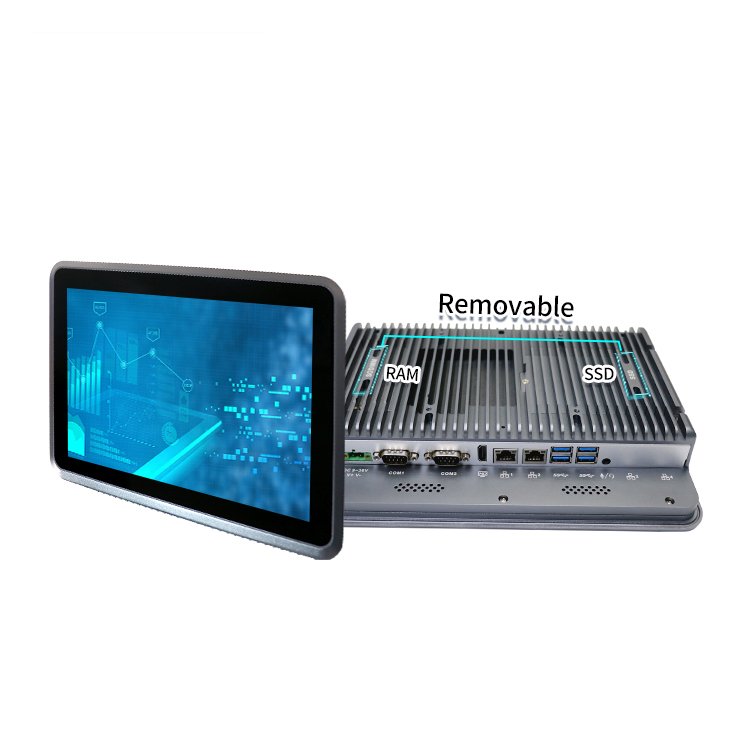
Robust thermal management and future-ready expandability are essential for uninterrupted performance in demanding conditions. Fanless designs eliminate moving parts through passive cooling—engineered heatsinks and thermally conductive chassis—that dissipate heat efficiently. This prevents dust ingress and mechanical failures while enabling operation in extreme temperatures (–40°C to 70°C), critical for environments like foundries or cold storage facilities. For long-term viability, future-proof I/O capabilities include modular interfaces (e.g., COM Express) supporting hardware upgrades over 10+ year lifecycles; PCIe expansion slots for integrating specialized cards without system replacement; and versatile connectivity—including legacy ports and high-speed USB—to ensure compatibility with existing and emerging equipment. This combination of passive cooling and scalable architecture minimizes maintenance costs and prevents premature obsolescence.
Application-Specific Integration: Mounting, I/O, and Human-Machine Interface Requirements
Mounting Flexibility and Certifications for Factory Floor, Rail, and Mobile Deployments
Selecting the best industrial PC requires adaptable physical integration for diverse environments. Factory floors demand vibration-resistant panel or rack mounts with IP-rated sealing against particulates. Rail applications need compact DIN rail compliance with shock absorption for constant movement. Mobile deployments require MIL-STD-810G validated vehicle mounts with anti-loosening hardware. Certifications like EN 50155 ensure resilience against 5–2000Hz vibrations and 50g shock impacts in transportation—guaranteeing operational stability where consumer-grade mounts would fail within months.
Display and Touch Capabilities: Sunlight-Readable Brightness, Glove-Operable Touch, and Industrial UI Standards
Industrial HMIs require specialized displays exceeding 1000 nits brightness for sunlight visibility, with matte anti-glare coatings reducing reflections by 70%. Touchscreens must support glove operation through pressure-sensitive resistive technology or capacitive systems detecting thick materials. UI standards enforce high-contrast layouts with ISO-compliant symbols and minimal menu layers—reducing errors during high-stress operations, as 23% of manufacturing incidents stem from interface misinterpretation. Tactile feedback and emergency stop placement follow ANSI/ISA-101 guidelines for intuitive crisis response.
FAQs
What is an IP rating, and why is it important for industrial PCs?
IP (Ingress Protection) ratings quantify a device's resistance to dust, moisture, and chemicals. Higher IP-rated devices, such as IP68, ensure better performance in harsh conditions.
Why do industrial PCs need extended temperature resistance?
Extended temperature resistance ensures reliable operation in extreme environments, such as steel mills or cold storage warehouses. It prevents issues like thermal throttling or startup failures.
What makes industrial SSDs different from consumer-grade SSDs?
Industrial SSDs are designed for durability and endurance, featuring over-provisioned NAND, wear-leveling algorithms, and robust thermal validation. They can withstand extreme temperatures and high write cycles, unlike consumer SSDs.
How does fanless cooling help industrial PCs?
Fanless cooling eliminates moving parts, reduces dust ingress, and ensures reliable operation in extreme temperatures, making it ideal for rigorous industrial conditions.
What certifications are crucial for industrial PC deployments?
Certifications like EN 50155 for railways and MIL-STD-810G for military deployments ensure resilience against shock, vibration, and extreme conditions, enhancing operational stability in diverse applications.
Table of Contents
- Ruggedness for Harsh Environments: IP Rating, Temperature, and Vibration Resistance
- Core Hardware Performance and Longevity: CPU, RAM, and Industrial-Grade Storage
- Thermal Management and Expandability: Fanless Design, Cooling Efficiency, and Future-Proof I/O
- Application-Specific Integration: Mounting, I/O, and Human-Machine Interface Requirements
- FAQs