 EN
EN

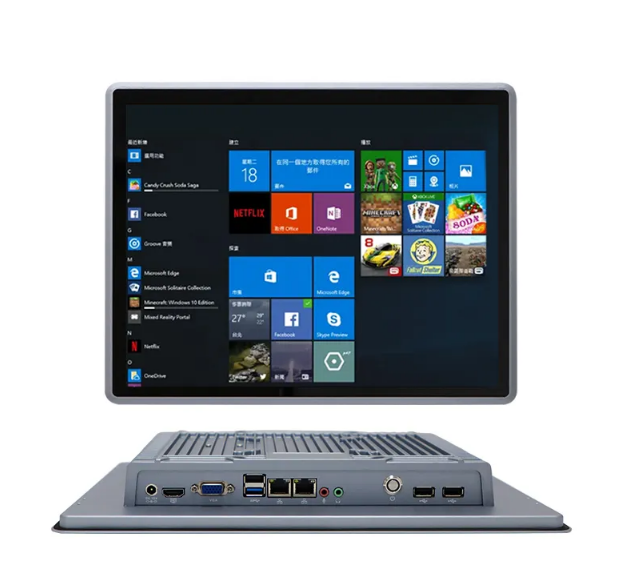
Rugged Durability for Demanding Industrial Environments
An industrial touch screen computer must survive where standard electronics fail. In modern factories, equipment faces constant stress from dust, vibration, moisture, and extreme temperatures—conditions that demand engineering built for continuity, not convenience.
IP65+ Sealing, Fanless Design, and Wide-Temperature Operation
Three core design principles ensure reliability in harsh environments. First, IP65+ sealing provides a complete barrier against fine dust and high-pressure water jets—critical in grinding, washdown, or outdoor-exposed zones. Second, fanless thermal management eliminates moving parts prone to clogging or failure; instead, solid-state cooling via oversized heatsinks delivers passive, maintenance-free heat dissipation. Third, wide-temperature operation supports stable performance across ambient ranges from –20°C to 70°C—validated per IEC 60068-2 environmental testing standards. Together, these features significantly extend service life and reduce unplanned downtime, which industry studies show can cost manufacturers over $20,000 per hour in high-throughput lines.
Chemical Resistance and Sunlight-Readable Displays
Industrial-grade displays go beyond ingress protection to withstand real-world chemical exposure and variable lighting. Chemically strengthened glass with proprietary anti-corrosion coatings resists degradation from cutting oils, solvents, and alkaline cleaners—common on metalworking and food processing floors. Enclosures use reinforced aluminum alloys engineered for impact resistance and long-term structural integrity. Meanwhile, sunlight-readable displays combine high-brightness LED backlights (1,000+ nits) with optical bonding—a process that laminates the display stack to eliminate air gaps. This prevents glare, internal condensation, and moisture ingress between layers, a leading cause of failure in non-bonded industrial monitors. The result is consistent legibility near open bay doors, under overhead halogen lighting, or in direct sunlight—ensuring operators maintain situational awareness and make precise, timely decisions.
Optimized Human-Machine Interaction with Industrial Touch Screen Computers
An industrial touch screen computer transforms operator engagement by embedding intuitive control directly into the machine interface. Removing external peripherals reduces clutter, cognitive load, and response latency—turning complex workflows into natural, smartphone-like interactions.
Gloved and Wet-Finger Operation Across Resistive and PCAP Technologies
Gloves and moisture are not edge cases—they’re daily realities in many production environments. Industrial touchscreens address this with purpose-built technologies: resistive touch panels respond reliably to pressure from gloved fingers, styluses, or tools—making them ideal for heavy-duty or safety-critical applications. Modern projected capacitive (PCAP) panels now support thin-glove and wet-finger operation through advanced sensor firmware and signal-processing algorithms, enabling seamless use in humid, oily, or washdown areas. This dual capability eliminates the operational friction—and contamination risk—of glove removal, saving critical seconds per interaction across thousands of daily touches.
Precision Input and Intuitive Control for Inspection and SCADA Tasks
Beyond basic command entry, industrial touchscreens support mission-critical tasks requiring accuracy and responsiveness. High-resolution PCAP panels deliver true multi-touch gesture support—enabling pinch-to-zoom on microscopic defect images during quality inspection. Resistive variants with >1000 PPI resolution provide pixel-level targeting for dense HMI layouts used in SCADA systems or control panel emulation. Direct manipulation—tap, swipe, drag—bypasses the mental translation required with mouse-and-keyboard interfaces, keeping focus on the process rather than the cursor. Customizable gesture shortcuts and tactile feedback further reduce error rates during alarm acknowledgment, trend analysis, or real-time parameter adjustment—proven in field deployments to cut operator task time by up to 32% compared to legacy HMIs.
Streamlined Operations Through Integrated HMI and Space-Saving Design
Industrial touch screen computers consolidate HMI, controller, and I/O functions into a single rugged unit—reducing component count, wiring complexity, cabinet footprint, and integration overhead. This unified architecture simplifies commissioning, troubleshooting, and software updates, while delivering centralized access to live data, batch management, and machine control. Operators benefit from contextual, role-based dashboards that surface only relevant information—accelerating training, improving situational awareness, and shortening reaction times to alarms or anomalies. As a result, changeover cycles shrink, line balancing improves, and overall equipment effectiveness (OEE) rises—key outcomes validated in multiple Tier 1 automotive and pharmaceutical facility deployments.
Future-Proof Integration with Industry 4.0 and Smart Factory Ecosystems
Software-Defined Interfaces and OT/IT Convergence Support
Modern industrial touch screen computers serve as intelligent edge nodes—not just display terminals. Their software-defined architecture enables runtime reconfiguration of HMI layouts, data tags, and logic without hardware swaps, supporting rapid line retooling or product changeovers. Built-in support for OPC UA, MQTT, and RESTful APIs ensures secure, standardized communication between shop-floor devices and enterprise IT systems—facilitating OT/IT convergence without compromising determinism or cybersecurity. This integration powers predictive maintenance models, real-time digital twins, and closed-loop process optimization—all processed at the edge to minimize latency. By acting as both data collector and decision enabler, the industrial touch screen computer becomes foundational infrastructure for adaptive, responsive smart manufacturing—aligned with ISA-95 and IEC 62443 security frameworks.