 EN
EN

The Shift from General-Purpose to Application-Specific Hardware
The industrial PC landscape in 2025 looks noticeably different from what it did even two years ago. General-purpose box PCs still have their place, but the real momentum sits with hardware designed around specific workloads. Machine vision, edge inference, and real-time control loops each place very different demands on a system—and a one-size-fits-all approach often leaves performance on the table.
Take the recent uptick in vision-guided robotics. A standard IPC with a consumer-grade GPU might handle inference, but sustained vibration, thermal cycling in unventilated enclosures, and the need for deterministic I/O response quickly separate purpose-built gear from repurposed office hardware. Manufacturers are increasingly segmenting their lines around use cases rather than just processor tiers. Some are spinning off dedicated SKUs for AI acceleration, others for multi-camera synchronization, and still others for low-latency motion control. The era of treating every industrial PC as a slightly ruggedized desktop is winding down.
This shift shows up in product roadmaps too. Several major IPC makers now offer modular I/O bays on their box PCs, letting integrators swap fieldbus cards or add vision-specific accelerators without swapping the whole unit. That flexibility matters in environments where downtime carries significant cost—not necessarily a catastrophic number, but enough that a 15-minute swap beats a two-hour chassis replacement any day.
The Quiet Revolution of Fanless Thermal Design
Fanless systems have been around for years, but 2025 marks a tipping point. The combination of more efficient processors—Intel’s latest embedded lines, AMD’s Ryzen Embedded offerings, and increasingly ARM-based designs—has made passive cooling viable for performance tiers that once required active fans. That opens up deployment scenarios that were previously off-limits.
Consider a deployment in a food processing facility. High-pressure washdowns happen daily. Even IP69K-rated systems with fans have a weakness: the fan itself pulls air—and with it, moisture and particulates—through the chassis. Over time, that compromises seals. Fanless designs eliminate that air exchange entirely. The chassis stays sealed, the internals stay clean, and the unit lasts longer between maintenance cycles. One facility in the Midwest running a network of panel PCs on a packaging line reported extending their preventive maintenance window from quarterly to biannually after switching to fanless units—not because the hardware was dramatically different, but because dust buildup on heatsinks was no longer a factor.
The market data backs up the trend. Analysts project that by 2035, fanless and ruggedized systems with AI acceleration capabilities could represent 60–70% of market value, up from an estimated 45–55% in 2026. That's a meaningful swing in less than a decade, and it reflects real purchasing behavior rather than vendor hype. Procurement teams are doing the math on total cost of ownership, and fanless designs consistently come out ahead in environments where dust, humidity, or vibration are part of the daily reality.
Edge AI Moves from Pilot to Production
Edge AI has been the talk of the industry for a few years, but 2025 is when it stopped being experimental. The conversation has shifted from “can we run inference at the edge” to “how do we operationalize it at scale.” That changes what manufacturers demand from their IPC partners.
In the past, an industrial PC with a mid-range CPU and a basic GPU was enough for proof-of-concept work. Production deployments are a different animal. They require sustained thermal performance under load, deterministic latency for control loops that depend on inference results, and remote management capabilities that let engineers update models without rolling a truck. The systems integrators (SIs) are expanding their demand for edge AI capabilities, and IPC vendors are responding with purpose-built edge AI systems.
One telling sign: the rise of on-premises large language model (LLM) deployments in industrial settings. Not for chatbots—nobody needs ChatGPT on the factory floor—but for maintenance logging, anomaly detection, and natural-language querying of machine data. These workloads need local compute because shipping sensor data to the cloud introduces latency and raises data sovereignty concerns. An IPC that can run a quantized LLM alongside real-time control loops is suddenly a very attractive proposition.
The numbers here are worth watching. The global edge AI market is projected to grow significantly through the end of the decade. Industrial applications are a major piece of that pie, and IPC manufacturers that have invested in AI-ready hardware are positioning themselves to capture that growth. The ones that haven't? They're playing catch-up.
Supply Chain Realignment and Regionalization
If there's one trend that has reshaped industrial PC manufacturing more than any technology shift, it's supply chain strategy. The pandemic-era disruptions taught the industry a hard lesson about over-reliance on single sources. 2025 finds manufacturers actively diversifying their supply bases, not just for components but for final assembly as well.
This plays out in a few ways. Some manufacturers are building redundancy into their component sourcing—qualifying second and third suppliers for critical parts like power regulators and memory modules. Others are moving assembly closer to their end markets. The Asia-Pacific region remains the largest market for industrial PCs, driven by rapid industrialization and rising demand for embedded computing solutions. But manufacturers are also establishing regional hubs in North America and Europe to serve those markets with shorter lead times.
The impact on product design is subtle but real. Regionalization favors modular architectures that can be configured locally rather than built to a single global spec. It also puts a premium on manufacturers that can manage multiple supply chains without compromising quality. The days of a single BOM serving every market are fading.
Human-Machine Interface Evolution
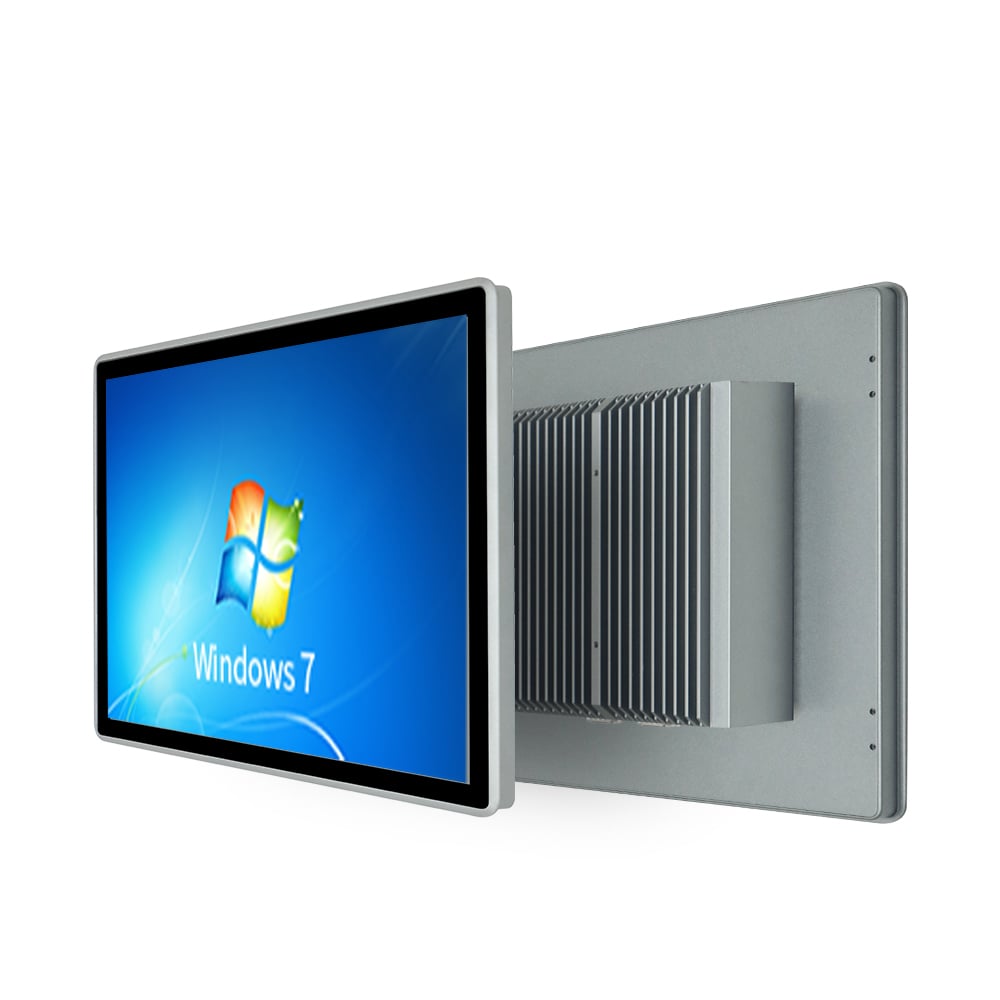
The panel PC—the touchscreen industrial computer mounted on equipment or control stations—is getting a serious upgrade in 2025. These aren't just displays with a PC tucked behind them anymore. They're becoming configurable edge compute platforms that sit at the intersection of durable hardware engineering and embedded software ecosystems.
What's driving this? Two things. First, operators expect interfaces that look and feel like consumer devices. A resistive touchscreen with a Windows CE interface doesn't cut it anymore. Second, the panel PC is increasingly the hub for local data aggregation and visualization. It's not just a window into the machine; it's a compute node that processes data from sensors, runs local analytics, and presents actionable insights to the operator.
The form factors are diversifying too. A 10-inch panel PC might be right for a compact control station, while a 21.5-inch unit suits a supervisory workstation. Manufacturers are offering more display sizes, more mounting options, and more touch technologies to match the specific needs of different environments. The panel PC market itself is projected to grow at a compound annual rate in the mid-single digits through the early 2030s.
The Integration of Cybersecurity by Design
Cybersecurity used to be an afterthought in industrial computing—something addressed with a bolt-on firewall or an air gap that everyone knew wasn't really an air gap. 2025 is different. Security is moving left in the design process, baked in at the hardware and firmware level rather than patched on later.
Trusted Platform Module (TPM) support is now table stakes. Secure boot is expected. But the deeper trend is around secure device onboarding, remote attestation, and over-the-air update mechanisms that don't introduce new vulnerabilities. Industrial PC manufacturers are also paying more attention to the supply chain security of their firmware—ensuring that what ships from the factory hasn't been tampered with somewhere along the way.
This matters because the attack surface has grown. More industrial PCs are connected, more are running complex software stacks, and more are accessible—directly or indirectly—from IT networks. A compromised IPC isn't just a data breach; it's a potential safety incident. Manufacturers that treat security as a feature rather than a checkbox are earning trust in a way that purely price-driven competitors cannot match.