 EN
EN

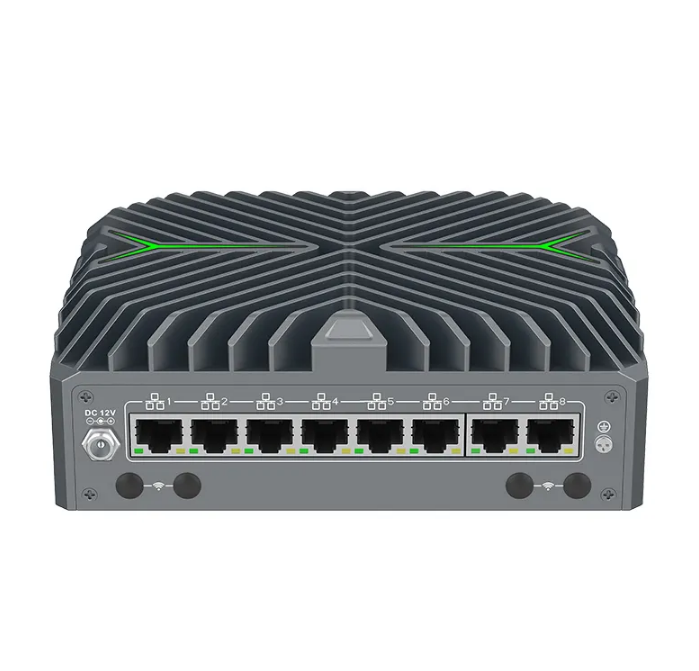
The Quiet Shift Toward Passive Cooling
Walk onto any factory floor built in the last decade, and the noise profile tells a story. The whir of cooling fans used to be as constant as the hum of conveyor belts. That sound is fading. More industrial control cabinets now sit silent, relying on passive cooling rather than spinning metal to keep processors within operating limits.
The numbers behind this shift are worth paying attention to. The global fanless industrial PC market was valued at roughly USD 913 million in 2024, with projections pointing toward USD 1.57 billion by 2031—a compound annual growth rate in the neighborhood of 8.1%. Meanwhile, the broader industrial PC market is expected to climb from around USD 5.5 billion in 2025 to USD 8.4 billion by 2031. Fanless systems are capturing a meaningful and growing slice of that total.
This isn't a niche trend driven by hobbyists or boutique system builders. The adoption curve reflects a fundamental rethinking of what reliability means in industrial computing. When a system runs 24/7 in environments filled with dust, vibration, and temperature extremes, every moving part becomes a liability. Removing fans eliminates one of the most common failure points in traditional computer hardware.
What Makes Fanless Design Different
The engineering principle behind fanless computing is straightforward: instead of forcing air across heatsinks with a spinning fan, the system relies on passive heat dissipation through the chassis itself. The enclosure—typically machined aluminum or another thermally conductive material—acts as a giant heatsink. Heat generated by the processor travels through thermal pads or direct contact interfaces into the housing, where it radiates into the surrounding air.
This approach imposes constraints. Passive cooling is less efficient than forced air convection, which means fanless systems generally use lower-power processors or operate with reduced thermal headroom under sustained loads. That trade-off is acceptable in most industrial applications, where consistent, predictable performance matters more than peak burst speeds.
What the design gains in return is significant. Without fans, there are no intake vents, which means no pathway for airborne particulates to enter the system. In environments where cement dust, metal shavings, or textile fibers are part of the daily air quality, this is not a minor convenience—it directly affects whether a system survives its first year of operation.
A Case from the Shop Floor
A food processing facility in the Midwest had been cycling through standard desktop PCs at an alarming rate. The equipment sat in a corner of the packaging area, not far from the flour dusters and seasoning applicators. Despite protective enclosures, fine particulate matter found its way into the systems. Fans would gum up, bearings would seize, and within six to eight months, each unit would be down for maintenance or replacement.
The maintenance logs told a clear story: fan failures accounted for nearly two-thirds of all hardware-related downtime in that section of the plant. Each failure meant stopping the line, swapping out the unit, and reconfiguring the replacement—a process that ate into production time and frustrated the operations team.
The facility eventually transitioned to fanless industrial systems across that packaging line. The enclosures were sealed, with no vents for dust to enter. Heat dissipated through the aluminum chassis, which was mounted to the cabinet frame for additional thermal mass. Over the following year, hardware failures in that area dropped to near zero. The systems ran continuously through seasonal temperature swings and the relentless fine dust that had previously killed multiple machines.
That experience isn't unique. Similar patterns show up in machining shops, chemical blending plants, and anywhere else where the air carries more than just oxygen.
The Reliability Advantage in Measurable Terms
Reliability in industrial computing is often discussed in terms of Mean Time Between Failures. The difference between fan-cooled and fanless systems in this metric is substantial.
Conventional industrial PCs with active cooling typically have an MTBF rating in the range of 10,000 hours. That translates to just over a year of continuous operation before statistical failure. Fanless industrial PCs, by contrast, frequently achieve MTBF figures between 37,000 and 50,000 hours—roughly four to five years of round-the-clock operation.
The primary reason for this gap is straightforward: fans are mechanical devices with bearings that wear out, motors that degrade, and blades that accumulate debris. They are the single most common point of failure in any computer system. Remove the fan, and that failure mode disappears.
| Factor | Fan-Cooled System | Fanless System |
|---|---|---|
| Moving parts | Multiple (fan motor, bearings) | None |
| Typical MTBF | ~10,000 hours | 37,000–50,000+ hours |
| Dust ingress pathway | Active intake vents | Sealed enclosure |
| Noise output | Audible (30–50 dBA) | Silent (0 dBA) |
| Temperature dependency | Ambient + airflow | Ambient + enclosure design |
| Maintenance frequency | Regular cleaning, fan replacement | Minimal |
The maintenance implications extend beyond just fan replacement. Systems with fans pull in dust, which settles on circuit boards and components. Over time, that dust acts as insulation, trapping heat and accelerating the degradation of capacitors and other sensitive parts. Fanless systems, with their sealed enclosures, avoid this compounding problem entirely.
Standards and Validation Frameworks
Evaluating fanless systems against established benchmarks requires looking beyond manufacturer claims. Several industry frameworks provide useful reference points.
Intel's Premium Industrial PC program, for example, establishes hardware specifications, software tuning levels, and reliability verification for industrial computing platforms. The program covers machine vision, industrial control, and panel IPC applications, with validation criteria that include thermal performance under real-world conditions. Platforms that align with these reference designs tend to offer more predictable behavior across different deployment environments.
IEC 61000-6-2 and EN 61000-6-4 are also relevant standards for industrial equipment, covering electromagnetic compatibility and immunity. Many fanless industrial systems are designed to meet these specifications, ensuring they can operate reliably alongside heavy machinery without interference or susceptibility issues.
For organizations evaluating fanless systems, these standards provide a baseline. A system that has undergone third-party validation or aligns with established reference designs is less likely to present surprises during deployment.
Where Fanless Makes Sense—and Where It Doesn't
The benefits of fanless computing are real, but they come with boundaries that deserve honest acknowledgment.
Strong fits:
-
Dusty or particle-heavy environments. Any setting where airborne debris is a fact of life—woodworking, food processing, mining, textiles—favors sealed, fanless designs.
-
Vibration-prone installations. Fans are sensitive to mechanical vibration. In mobile equipment or near heavy stamping presses, fanless systems hold up better.
-
Noise-sensitive areas. Laboratories, medical facilities, and quality control rooms benefit from silent operation.
-
Remote or hard-to-access locations. When a system is mounted on a high ceiling or inside a cramped cabinet, maintenance visits are costly. Longer MTBF reduces those visits.
Trade-offs to consider:
-
Thermal limits. Passive cooling cannot match the heat dissipation capacity of forced air. Fanless systems are best suited for processors with moderate thermal design power. High-end CPUs under sustained load may throttle or require derating.
-
Enclosure size. Effective passive cooling requires sufficient surface area. Fanless systems often have larger or finned enclosures compared to actively cooled counterparts of similar performance.
-
Cost structure. The machined aluminum enclosures and thermal engineering required for passive cooling can push initial costs above comparable fan-cooled systems. The total cost of ownership often favors fanless over the long term, but the upfront premium is real.
The decision ultimately depends on the deployment environment and the operational priorities of the organization. For some applications, active cooling remains the practical choice. For others, the reliability gains of fanless design are non-negotiable.
Practical Considerations for Deployment
Switching to fanless systems isn't just about swapping out hardware. Several operational factors come into play.
Mounting matters. Passive cooling relies on the chassis radiating heat into the surrounding air. If a fanless system is installed in a tightly enclosed cabinet with poor airflow, the heat has nowhere to go. The system may reach thermal limits even under moderate loads. Providing adequate clearance around the enclosure—or using the cabinet frame as additional heat sink surface—makes a measurable difference.
Processor selection requires attention. A fanless system's thermal budget is fixed by the chassis design. Choosing a processor that exceeds that budget means the system will throttle performance or risk thermal shutdown. Matching the workload to the thermal capability is more important than chasing the highest spec sheet numbers.
Environment characterization matters. A system rated for -20°C to 50°C ambient operation will perform differently in a 45°C factory with direct sunlight on the cabinet versus a climate-controlled control room. Understanding the actual thermal profile of the deployment location helps avoid over-optimistic assumptions.
Looking Ahead
The trajectory of fanless computing in industrial settings points toward continued growth. As processors become more power-efficient, the thermal gap between active and passive cooling narrows. More workloads become viable on fanless platforms without performance compromise. Meanwhile, the operational costs of fan maintenance and downtime continue to push organizations toward sealed, low-maintenance designs.
Companies that specialize in fanless industrial systems—such as XSKIPC—have built their manufacturing and quality control processes around the specific demands of passive cooling. Their experience with enclosure design, thermal validation, and component selection provides a foundation for organizations looking to adopt fanless solutions across production environments. The shift away from spinning fans is not a passing trend; it reflects a fundamental alignment between hardware design and the realities of industrial operations.