 EN
EN

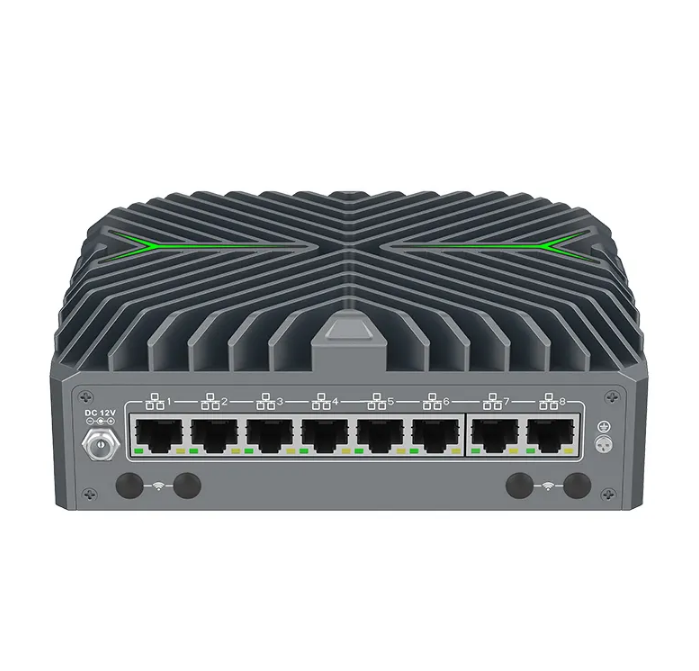
Core Security Capabilities of a Modern Firewall Router
Modern firewall routers integrate multiple security functions into a single device, offering protection well beyond basic packet filtering. These systems combine connection tracking, encryption enforcement, and proactive updates to defend against evolving threats.
Stateful Packet Inspection, WPA3 Encryption, and Automated Firmware Updates
Stateful packet inspection (SPI) is foundational: it monitors the state of active connections and permits only traffic that matches established sessions—blocking forged packets and preventing session hijacking. On the wireless side, WPA3 encryption delivers stronger authentication and forward secrecy than WPA2, significantly raising the bar for eavesdropping and offline dictionary attacks. Equally vital is automated firmware updates, which ensure timely delivery of critical security patches without reliance on manual intervention. Delayed patching leaves known vulnerabilities exposed; automated updates close that window consistently. Together, SPI, WPA3, and automated firmware updates form the essential security triad every modern firewall router must deliver to maintain a resilient perimeter.
Advanced Threat Mitigation: Content Filtering, IoT Device Visibility, and Zero Trust Network Access (ZTNA)
Beyond baseline protections, advanced firewall routers address today’s complex attack surface with layered, adaptive controls. Real-time content filtering analyzes URLs and domains to block access to phishing, malware-hosting, and malicious sites—reducing initial infection vectors. IoT device visibility tackles a growing blind spot: smart thermostats, cameras, and sensors often lack built-in security and operate outside traditional policy scopes. Modern firewall routers automatically discover, classify, and segment these devices, applying granular policies that restrict communication to authorized services only. Zero Trust Network Access (ZTNA) shifts away from implicit trust—even inside the network—by continuously verifying identity, device posture, and context before granting resource access. This combination of content filtering, IoT segmentation, and ZTNA provides defense-in-depth against targeted attacks, ransomware lateral movement, and unauthorized data exfiltration.
Network-Specific Firewall Router Requirements
Matching Throughput, Concurrent Users, and Scalability to Your Environment
A firewall router’s performance must match your organization’s real-world demands—not just peak bandwidth, but sustained throughput under full security inspection. Basic firewall throughput ranges from 700 Mbps in compact appliances to 20 Gbps in high-end models; next-generation firewall (NGFW) throughput typically falls between 300 Mbps and 8 Gbps when deep packet inspection, TLS decryption, and threat prevention are enabled. VPN throughput varies widely—from 300 Mbps to 10 Gbps—depending on encryption strength and hardware acceleration. These figures are highly sensitive to packet size and testing methodology (e.g., RFC 2544 vs. EMIX), so vendor claims should be validated under realistic load conditions. Equally important is concurrent user capacity: latency spikes or session drops under peak usage signal inadequate processing headroom. Scalability is non-negotiable—selecting a model with modular expansion, software-defined licensing, or cloud-managed upgrade paths avoids costly rip-and-replace cycles as user counts grow from 200 to 500 or more.
Hardware, Virtual, and Cloud-Native Firewall Router Deployment Options
Firewall routers deploy across three complementary forms—each optimized for distinct infrastructure needs. Hardware appliances provide deterministic performance, physical port density, and low-latency forwarding, making them ideal for edge gateways, branch offices, and data center perimeters. Virtual firewalls run as software instances on industry-standard hypervisors (e.g., VMware ESXi, Microsoft Hyper-V), enabling rapid provisioning, consistent policy enforcement across hybrid environments, and seamless integration with SD-WAN or microsegmentation strategies. Cloud-native firewalls—such as those delivered as managed services via AWS Gateway Load Balancer or Azure Firewall—are fully elastic, auto-scaling with workload demand and reducing operational overhead through centralized telemetry and policy orchestration. Most mature deployments adopt a hybrid approach: hardware at the network edge, virtual instances for internal segmentation, and cloud-native firewalls protecting SaaS and IaaS workloads.
Firewall Router vs. Standalone Router: Functional Overlap and Critical Differences
Firewall routers and standalone routers both route IP traffic—but their security postures diverge fundamentally. Standalone routers prioritize connectivity: they perform NAT, DHCP, and basic static routing with minimal inspection depth. Firewall routers embed purpose-built security engines—including stateful inspection, application-aware filtering, and intrusion prevention—that actively analyze traffic behavior, detect anomalies, and enforce policy in real time. This distinction translates directly to risk reduction: organizations using integrated firewall routers reduce their exploitable attack surface by 63% compared to standalone router deployments, according to 2023 network security benchmarks from NIST and the SANS Institute. The core differentiator isn’t just what the device does—it’s how proactively it defends. A firewall router treats every packet as a potential threat until proven otherwise; a standalone router assumes legitimacy by default.
Threat Detection Performance: AI Analytics, Sandboxing, and Encrypted Traffic Inspection
Balancing SSL/TLS Decryption Benefits Against Privacy and Performance Trade-offs
SSL/TLS decryption is now indispensable for threat detection—91% of malware leverages encryption to evade legacy scanners (2024 Cybersecurity Report, Verizon DBIR). Modern firewall routers use decryption to enable AI-driven behavioral analytics, which identifies command-and-control patterns and anomalous lateral movement, and sandboxing, which detonates suspicious files in isolated environments to uncover zero-day exploits. Yet full decryption carries tangible trade-offs: privacy implications for user data, compliance friction in regulated sectors (e.g., HIPAA, GDPR), and measurable performance impact—up to 45% throughput reduction on mid-tier hardware without hardware acceleration. Leading solutions mitigate this through strategic, policy-driven decryption: inspecting only high-risk categories (e.g., executable downloads, unknown domains), leveraging dedicated crypto processors, and excluding sensitive destinations (e.g., banking, health portals) by default. This balanced approach preserves detection fidelity while honoring performance SLAs and regulatory boundaries.