 EN
EN

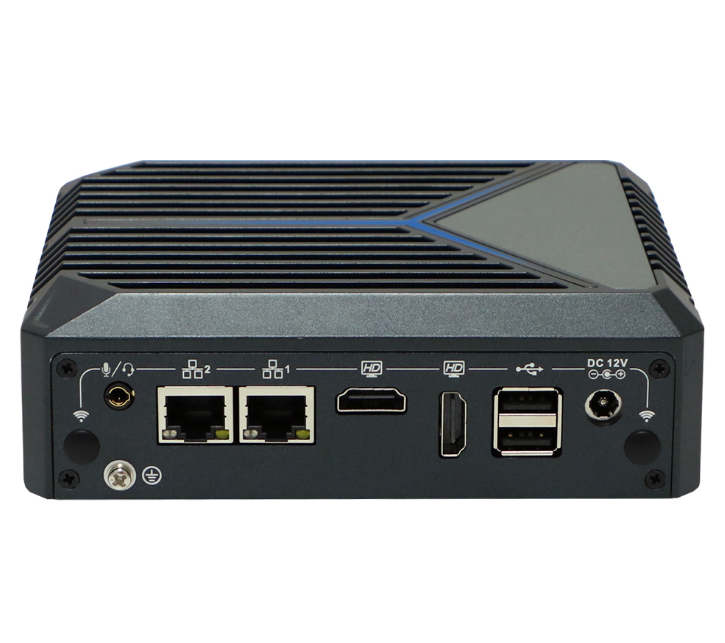
How Fanless Computers Achieve Silent, Dust-Free, and Highly Reliable Operation
Eliminating Fans: The Foundation of Noise Reduction and Sealed-Enclosure Durability
Fanless computers remove the most failure-prone component in traditional systems: the cooling fan. With no spinning blades, they produce zero audible noise—ideal for sound-sensitive environments like hospital corridors, libraries, and open-plan offices. This fan-free design also enables a fully sealed chassis, blocking dust, metal shavings, and airborne contaminants from entering the system. As a result, reliability improves dramatically in demanding settings such as factories, warehouses, and outdoor kiosks. The absence of moving parts minimizes wear and tear, yielding a higher Mean Time Between Failures (MTBF) and enabling true 24/7 operation. Many models meet IP5x or IP6x ingress protection standards, delivering certified resistance to dust—and even water jets—in rugged deployments. Maintenance is drastically reduced: no fan cleaning, replacement, or recalibration is required, lowering total cost of ownership. By removing the root cause of noise and contamination, fanless computers deliver silent, dependable computing out of the box.
Passive Cooling in Action: Thermal Stability Across Harsh Industrial Environments
Without fans, heat dissipation relies entirely on passive thermal engineering. Fanless computers use large aluminum or copper heat sinks, vapor chambers or heat pipes, and the chassis itself as a thermal conductor to draw heat away from the CPU and GPU. This approach leverages natural convection—not forced airflow—to transfer thermal energy safely into the surrounding environment. Rigorously validated against IEC 60068-2-14 for thermal cycling, these systems operate reliably across extreme ambient temperatures—from –20°C to 70°C—making them ideal for outdoor digital signage, vehicle-mounted controls, and energy substations. Their solid-state construction also provides exceptional resistance to shock and vibration, meeting MIL-STD-810G requirements for industrial robotics, CNC machinery, and rail or fleet applications. In mission-critical settings where active cooling fails under stress, fanless designs sustain performance without throttling or interruption.
Critical Applications Where Fanless Computers Deliver Unmatched Operational Advantages
Medical & Healthcare Settings: Silent, Sterile, and Maintenance-Free Performance
In healthcare environments, silence and sterility are non-negotiable. Fanless computers operate below 25 dB—quiet enough for intensive care units and MRI suites—while their sealed, dust-proof enclosures prevent microbial ingress in operating rooms and laboratories. With no fans to clog or degrade, routine cleaning and mechanical maintenance are eliminated. Real-world data shows fanless deployments reduce unplanned downtime by up to 30% compared to fan-cooled alternatives. These systems power patient monitoring, medical imaging workflows, and secure data logging without compromising hygiene or uptime—even when embedded in mobile medical carts or wall-mounted cabinets.
Transportation, Manufacturing, and Edge IoT: Resilience Against Vibration, Shock, and Wide-Temperature Swings
Industrial and mobile applications demand electronics that withstand relentless mechanical and thermal stress. Fanless computers excel where fan-cooled PCs falter: they meet MIL-STD-810G for shock and vibration, making them standard in factory automation, robotic controllers, and conveyor systems. On trains, buses, and commercial fleets, they run GPS tracking, passenger information displays, and onboard surveillance continuously—despite constant motion and wide temperature swings. At remote edge locations—including wind farms and electrical substations—they maintain stable operation from –20°C to 60°C ambient, with low power draw (often under 15 W) supporting battery-backed or off-grid use. Fewer failure points translate directly to longer MTBF and lower TCO across transportation, manufacturing, and energy infrastructure.
Thermal Design Fundamentals of Fanless Computers
Heat Sinks, Heat Pipes, and Convection Optimization for Sustained Performance at 60°C Ambient (IEC 60068-2-14)
Passive thermal management is the cornerstone of fanless reliability. Large, finned aluminum or copper heat sinks draw heat directly from the CPU and chipset. Heat pipes—sealed copper tubes containing a phase-change fluid—efficiently shuttle thermal energy from hotspots to the outer fins. The entire chassis often functions as an extended heatsink, while carefully engineered convection paths ensure natural airflow carries heat away—even inside sealed enclosures. This integrated approach delivers sustained, throttle-free performance at ambient temperatures up to 60°C, verified through IEC 60068-2-14 thermal cycling tests. It’s this precision thermal architecture—not just the absence of fans—that enables silent, dust-free, and long-life operation in harsh industrial conditions.
Selecting the Right Fanless Computer: Key Considerations for Performance, Certification, and Longevity
Choosing the right fanless computer requires aligning technical specifications with real-world operational demands. Begin with processor selection: match the CPU’s thermal design power (TDP) to your workload. Low-power chips (e.g., Intel Atom or AMD Embedded R-series <15 W) suit data logging or HMI control; higher-performance options (e.g., Intel Core i3–i7 U- or H-series, up to 35 W TDP) support real-time video analytics or lightweight edge AI—but only if paired with proportionally robust passive cooling. Next, evaluate environmental resilience: extended temperature range (–20°C to 60°C+), IP65/IP67 ingress protection, and MIL-STD-810G certification are essential for factory floors, vehicles, or outdoor use. Regulatory compliance—CE, FCC, UL, and, where applicable, FDA 510(k) or IEC 62304—is mandatory for medical, automation, and safety-critical deployments. Finally, prioritize power efficiency: wide-input DC support (9–36 VDC), low idle consumption, and surge-tolerant circuitry extend service life and simplify integration into existing power infrastructures. By systematically weighing performance, environment, certifications, and power, you ensure a fanless solution built not just to run—but to endure.
Table of Contents
- How Fanless Computers Achieve Silent, Dust-Free, and Highly Reliable Operation
- Critical Applications Where Fanless Computers Deliver Unmatched Operational Advantages
- Thermal Design Fundamentals of Fanless Computers
- Selecting the Right Fanless Computer: Key Considerations for Performance, Certification, and Longevity