 EN
EN

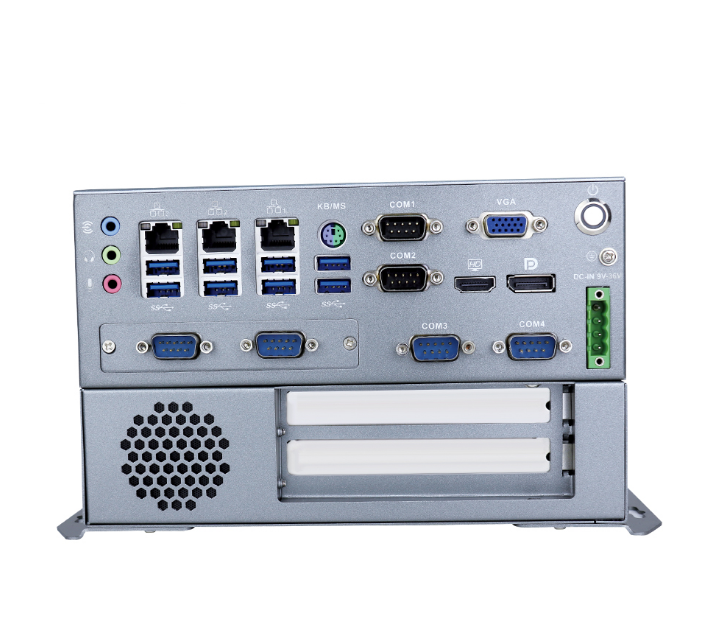
Why a Mini PC with PCI Slot Breaks the Compact-Performance Trade-Off
Debunking the Myth: How Modern SFF Designs Support Full PCIe x16 Lanes Without Compromising Thermals or Power
The notion that compact systems can’t deliver full PCIe x16 bandwidth stems from outdated Mini-ITX constraints—limited expansion, weak power delivery, and thermal bottlenecks. Today’s small-form-factor (SFF) engineering has redefined what’s possible. Leading Mini PCs now feature true PCIe x16 slots wired directly from the CPU, supporting high-wattage GPUs, capture cards, and network adapters without throttling. These systems combine vapor-chamber cooling, precision airflow channels, and adaptive fan curves to sustain performance under load. A well-designed unit can run a 75–150 W add-in card while keeping the CPU within a 35–65 W thermal envelope—enabled by segregated intake/exhaust zones and robust DC-DC power supplies (up to 300 W). With modern VRM designs and stable voltage regulation, power is no longer the limiting factor. The result? A workstation-class Mini PC that matches tower-level expandability—proving compactness need not mean compromise.
Key Differentiators: Identifying Genuine Mini PCs with PCI Slot vs. Marketing-Labeled 'Expandable' Models
Not all “PCI-expandable” Mini PCs deliver real PCIe capability. Some use M.2-to-PCIe risers limited to x4 lanes; others feature a slot in name only—routing just one lane behind the connector and capping bandwidth at under 1 GB/s. To distinguish authentic solutions, verify three core specs: physical lane allocation, power delivery capacity, and BIOS configurability. A genuine system dedicates at least eight (ideally x16) PCIe lanes directly from the CPU or PCH, supplies ≥75 W via the slot (with optional 6-pin auxiliary power), and exposes full BIOS controls for PCIe generation (Gen4/Gen5) and link configuration. Also assess physical integration: true models align with standard low-profile add-in-card brackets and allow installation without removing the top cover. Procurement teams who validate these criteria avoid costly missteps—like deploying a “PCI slot” system incapable of hosting the GPU or 10GbE NIC required for enterprise AI, vision, or virtualization workloads.
Real-World Performance Gains Enabled by a PCI Slot in Mini PCs
GPU Acceleration and AI Workloads: Local PCIe GPUs vs. Thunderbolt eGPUs in Creative & Edge AI Scenarios
A native PCIe GPU transforms a Mini PC into a local AI inference node or creative powerhouse—without the latency and bandwidth penalties of Thunderbolt eGPUs. While Thunderbolt caps throughput at ~40 Gbps (effectively PCIe x4), direct x16 attachment delivers up to 64 Gbps (Gen4) or 128 Gbps (Gen5), eliminating bottlenecks in real-time rendering and model execution. In DaVinci Resolve or Unreal Engine, this means zero frame drops during 4K timeline scrubbing or physics simulation. For edge AI—like security analytics or medical imaging—the difference is measurable: local PCIe attachment cuts inference latency by up to 60% versus Thunderbolt alternatives. NVIDIA A2000 GPUs, widely deployed in compact AI edge systems, achieve 2.3× faster TensorFlow throughput on native PCIe versus Thunderbolt when processing 4K video streams.
High-Speed I/O Expansion: 10GbE Networking, NVMe RAID Arrays, and Low-Latency Vision Systems
Beyond graphics, the PCI slot unlocks mission-critical I/O scalability—turning constrained hardware into high-throughput nodes:
- Network Acceleration: 10GbE NICs enable NAS clustering and virtualized infrastructure, delivering 900 MB/s file transfers—nearly 8× faster than standard 1GbE.
- Storage Scalability: PCIe 4.0 x4 NVMe RAID controllers support RAID 0/10 configurations with sequential reads exceeding 7,000 MB/s—vital for 8K RAW editing or transactional databases.
- Machine Vision: Industrial frame grabbers leverage PCIe’s deterministic timing for sub-millisecond latency—unachievable via USB3 Vision or Ethernet-based interfaces.
| Expansion Type | Bandwidth | Use Case Advantage |
|---|---|---|
| 10GbE NIC | 10 Gbps | Real-time 4K video streaming |
| NVMe RAID | PCIe 4.0 x4 | 8K RAW video editing buffer |
| Camera Link | 850 MB/s | Robotic quality inspection |
This native, low-latency expansion makes Mini PCs viable where rack space is scarce but performance is non-negotiable—especially in edge computing, broadcast, and industrial automation.
Critical Use Cases for a Mini PC with PCI Slot
Industrial & Embedded Deployments: Medical Imaging, Factory Automation, and Real-Time Data Acquisition
In mission-critical industrial environments—where uptime, ruggedness, and deterministic I/O are essential—a Mini PC with PCI slot serves as a hardened compute backbone. In medical imaging, a PCIe x16 GPU accelerates CT/MRI reconstruction and real-time 3D visualization, directly supporting clinical decision-making. Factory automation systems integrate motion control cards, industrial frame grabbers, or fieldbus modules (e.g., EtherCAT, Profibus) via the slot—enabling synchronized sensor data acquisition from PLCs and robotic arms. Unlike consumer Mini PCs, these units operate reliably across wide temperature ranges (–20°C to 60°C), resist vibration, and support 24/7 operation. Native PCIe expansion eliminates USB or Thunderbolt bottlenecks, allowing engineers to deploy 10GbE for real-time telemetry or NVMe RAID for local edge preprocessing—making the system a self-contained node for time-sensitive applications.
Professional Creative Studios: On-Set Rendering, Video Encoding Farms, and Portable VFX Workstations
Creative studios benefit from a rare combination: workstation-grade performance in a portable, rack-dense package. A Mini PC with PCI slot hosts full-height GPUs for GPU-accelerated rendering in DaVinci Resolve or Adobe Premiere—enabling editors to grade 4K footage on-set without hauling towers. For encoding farms, multiple Mini PCs with PCIe slots form scalable, rack-mountable arrays—reducing spatial footprint by up to 60% versus traditional servers. The slot also supports professional audio interfaces and SDI/HDMI capture cards for low-latency monitoring and live grading. This architecture delivers portability without performance trade-offs—and crucially, maintains upgrade paths: swapping a GPU or adding a 10GbE NIC extends the platform’s relevance across production cycles and software updates.
Long-Term Value: Upgradeability, Future-Proofing, and TCO Advantages
A Mini PC with PCI slot delivers long-term value through modular upgradeability—not just initial performance. Unlike sealed or soldered designs, it allows targeted component replacement: upgrading from an A2000 to an RTX 6000 Ada GPU, adding a second 10GbE NIC for redundancy, or installing a Gen5 NVMe RAID controller as storage demands evolve. This flexibility extends the system’s useful life by 3–5 years, avoiding full-platform refreshes. From a total cost of ownership (TCO) perspective, organizations reduce capital outlay: pay once for the chassis and incrementally invest in upgrades aligned with workload shifts. Maintenance is faster and less disruptive—replacing a faulty PCIe card takes minutes versus shipping an entire unit for repair. For IT teams managing distributed edge deployments or creative fleets, this modularity transforms a fixed hardware expense into an adaptable, future-proof asset—one that scales with technology, not against it.