 EN
EN

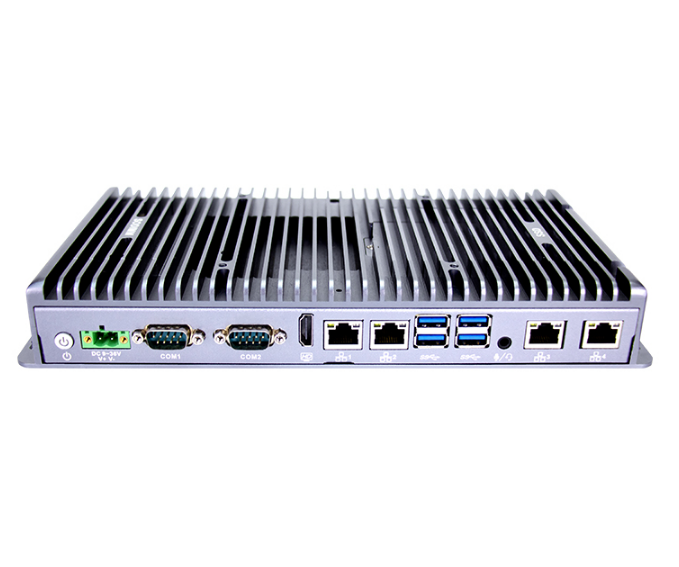
What Is an Industrial Computer? Core Design and Ruggedization Principles
IP65/NEMA 4 Enclosures, Wide-Temperature Operation, and Shock/Vibration Tolerance
An industrial computer is engineered to operate reliably where a standard desktop would quickly fail. Its most visible protection is the enclosure: IP65 or NEMA 4 ratings ensure full resistance to dust ingress and low-pressure water jets—critical for deployment near coolant sprays in machining cells or in dusty woodworking environments. Beyond sealing, these systems support wide-temperature operation, typically from –20°C to 60°C (or broader), eliminating dependence on climate-controlled cabinets. Mechanical resilience is equally foundational: internal components are secured using shock-absorbing mounts and reinforced PCBs to withstand continuous vibration from nearby motors and occasional impact from handling or equipment movement. Together, sealed enclosures, thermal robustness, and mechanical hardening form the three non-negotiable pillars of industrial-grade reliability—enabling true 24/7 operation in conditions that would disable consumer hardware within hours.
Purpose-Built Hardware: Watchdog Timers, Fanless Cooling, and High-Brightness Touch Interfaces
Durability must be matched by operational continuity and human-centered usability. Watchdog timers provide autonomous recovery: if software hangs or crashes, the hardware triggers an immediate reset—restoring function without manual intervention. Fanless cooling replaces moving parts with passive heatsinks, removing a key failure point while preserving enclosure integrity and supporting the IP65/NEMA 4 rating. For operator interaction, high-brightness (1,000+ nits) touchscreens feature optical bonding and glove-compatible layers, ensuring legibility under direct sunlight or intense factory lighting. Paired with industrial-grade I/O (e.g., isolated digital inputs, CAN bus, M12 connectors), these features transform raw computing power into a purpose-built automation platform—designed not just to survive, but to perform consistently across decades of service.
How Industrial Computers Enable Workflow Modernization
Industrial computers are pivotal in replacing manual oversight with real-time control and conditional automation (“If-Then” logic). They execute deterministic rules—such as halting a conveyor when temperature exceeds a safety threshold—reducing human intervention by up to 40% in assembly lines and accelerating response times while minimizing error (McKinsey & Company, The State of AI in Manufacturing, 2023).
Unifying Data Flow: Integrating MES, IoT Sensors, and Cloud Platforms via Industrial Computer Gateways
As intelligent gateways, industrial computers unify fragmented data sources—converting protocols from Manufacturing Execution Systems (MES), legacy PLCs, and heterogeneous IoT sensors into coherent, time-synchronized streams. This integration powers predictive analytics and live operational dashboards. For instance, pairing vibration sensors with lightweight edge AI models enables failure forecasting up to 72 hours in advance, increasing equipment uptime by 25%. By resolving data silos at the source, industrial computers turn raw telemetry into actionable intelligence—optimizing labor, energy, and maintenance resources without requiring cloud dependency.
Industrial Computer Roles in Smart Factories and Industry 4.0
Within Industry 4.0, the industrial computer serves as the essential bridge between physical production and digital intelligence. By embedding processing power directly on the factory floor, it enables real-time decision-making with sub-10ms latency—bypassing network bottlenecks and cloud round-trip delays. This local autonomy is foundational to responsive automation, closed-loop quality control, and adaptive scheduling—making industrial computers the operational backbone of smart factories.
Edge AI Deployment: On‑Device Predictive Maintenance and Anomaly Detection
Modern industrial computers run optimized AI inference engines at the edge, analyzing sensor data in milliseconds—not seconds. On-device predictive maintenance detects early signs of degradation—such as spectral anomalies in motor vibration or thermal drift—triggering alerts or automated mitigation before failure. Anomaly detection algorithms continuously compare live readings against validated baselines, identifying subtle deviations indicative of jammed conveyors, bearing wear, or electrical imbalances. Because all processing occurs locally, operations remain uninterrupted during network outages, and bandwidth demands stay minimal. The result is measurable: unplanned downtime drops significantly, asset lifespans extend, and maintenance shifts from reactive or calendar-based to truly condition-driven—all from a single, ruggedized platform.
Real-World Impact: Automotive Production Case Study
In automotive manufacturing—where tolerances are tight and downtime costs exceed $20,000 per minute—industrial computers deliver measurable ROI. At a Tier 1 supplier plant, manual quality checks once consumed 15% of production time. After deploying rugged industrial PCs with integrated machine vision, defect detection shifted from sampling-based inspection to real-time, 100%-coverage analysis. Defect escape rates fell by over 30%, and inspection labor costs dropped 40% within 18 months. Simultaneously, those same units served as edge gateways—collecting and analyzing vibration and thermal data from robotic arms. Local edge AI models enabled predictive maintenance that reduced unplanned downtime by 25%, yielding approximately $740,000 in annual savings (Ponemon Institute, The Economic Impact of Edge Intelligence in Automotive Manufacturing, 2023). This dual role—as both process controller and data unifier—exemplifies how purpose-built industrial computers accelerate the transition from traditional to agile, insight-driven manufacturing.