 EN

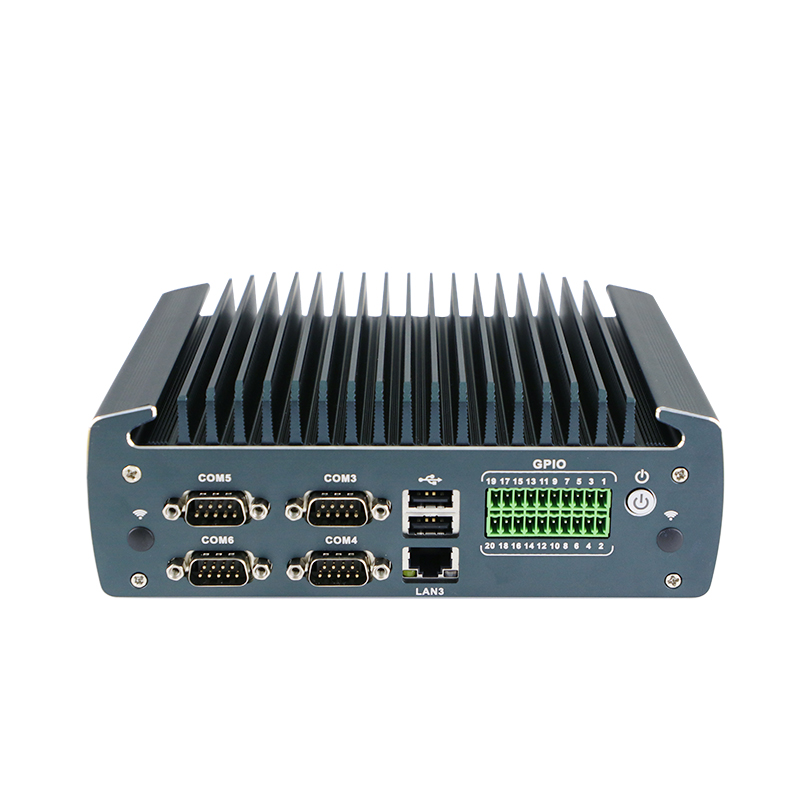
The pitch for Industry 4.0 often starts in the cloud, but the data that makes it work starts at the machine. A press, a welder, or a filling head generates status bits, torque curves, and fault codes long before any dashboard sees them. Sending every raw signal to a distant server adds latency, bandwidth cost, and a failure path that production cannot afford. That gap is where embedded PCs earn their place. These compact industrial computers sit beside the equipment, collect data at the source, and decide what to forward, what to buffer, and what to act on locally. The move is not about replacing the PLC. It is about giving the PLC a capable neighbor that speaks modern protocols and survives the same dirt and vibration as the machine.
The Data Path That Makes or Breaks a Smart Line
A clean data path has three layers. The controller keeps real-time motion and interlock logic. The embedded PC handles protocol translation, local storage, and edge computing tasks such as filtering, timestamping, and alarm pre-processing. The plant network or cloud receives summarized data. OPC UA, standardized as IEC 62541, is common at the middle layer because it carries structured information and supports security features that older fieldbus tools lack. Modbus TCP and MQTT often sit alongside it. A few practical rules show up in almost every integration:
-
Keep safety and motion control on the controller, not on the edge computer.
-
Buffer data through short network drops so a server outage does not erase production history.
-
Time-stamp at the source, because later reconstruction is guesswork.
-
Limit outbound traffic to what the business system actually needs.
That last point matters. An edge node that forwards every raw tag can flood a plant historian and hide the useful signal.
What an Embedded PC Brings to the Edge, and What It Does Not
An industrial embedded computer is not a smaller desktop. It is a sealed appliance built around long-life components, a fixed I/O map, and passive cooling in many designs. The trade-offs become clear when the edge node is compared with a split PLC, gateway, and box PC setup.
| Criterion | Split cabinet architecture | Embedded PC at the machine |
|---|---|---|
| Data latency | Extra gateway hops | Local collection and filtering |
| Protocol handling | Gateway dependent | OPC UA, Modbus TCP, MQTT on one node |
| Panel footprint | Multiple boxes and power supplies | One compact unit near the equipment |
| Expansion | Cards and drives can be added | I/O fixed at specification |
| Environmental fit | Depends on cabinet and fan filters | Sealed fanless design often fits dust and washdown |
| Maintenance | More cables and separate power bricks | Fewer connections, no fan filter changes |
| Best fit | Heavy vision, large databases, changing scope | Machine data collection, HMI, local buffering |
The limits are real. A fanless design usually runs a low-power processor, so a workload that needs a GPU or a high-end capture card belongs in a cabinet box PC. Expansion slots are scarce by design. Thermal headroom is set by the chassis surface, not by a fan curve. An edge node that is over-specified for analytics will throttle or fail early. The honest answer is to match the box to the workload, not to force every task into one sealed panel.
A Retrofitted Assembly Cell Shows the Real Trade-Offs
An automotive parts plant offers a useful picture. The original cell had a PLC, a protocol gateway, and a fan-cooled box PC inside a cabinet. The cabinet sat near a vibratory feeder, and fine metal dust pulled through the filter every few weeks. Production data reached the MES only when the gateway stayed online, and downtime events were reconstructed from operator notes. The retrofit put a fanless embedded PC at each cell, running an OPC UA server and a local store-and-forward buffer. The sealed unit tolerated the dust and the 40 C ambient temperature without a filter change. The PLC kept its real-time duties. The surprise came from the vision inspection step, which needed a PCIe frame grabber. That card stayed in a box PC inside a cleaned cabinet, and the embedded node handled only the data and HMI work. The project worked because the team mapped the thermal and expansion limits before ordering hardware. It also segmented the edge node into its own network zone, since a data collector with a network port is still an attack surface.
Security and Standards Decide Whether the Edge Survives
An edge computer on a factory floor is a network device, and treating it as a dumb terminal is how plants get burned. IEC 62443 defines zones and conduits for industrial automation and control systems, and an embedded node belongs in a zone with a documented conduit to the business network. OPC UA security features help, but they do not replace patching, account control, and signed firmware updates. A practical setup keeps the edge node on a separate VLAN, allows only required ports, and logs access. The limitation is operational: many small plants lack a patch window for production hardware. That makes remote management and rollback support part of the specification, not an afterthought. Security is also a reason to avoid unknown white-box hardware. A stable board design and a controlled bill of materials are boring advantages until a supply chain substitution changes the network stack.
Matching Hardware to the Job Without Overbuilding
The selection process starts with the thermal budget and the I/O count, not with the fastest processor on the list. A machine data collector needs serial ports, dual Ethernet, wide voltage input, and a fanless design that fits the panel cutout. A local HMI needs a readable display and a touch sensor that works with gloves. A vision pre-processing node needs expansion and active cooling, and it probably belongs in a cabinet. Lifecycle matters too. A fixed I/O map and a stable board supply keep a validated cell reproducible when the line is copied to another plant. Shenzhen Xin Saike Technology supports integrators with industrial embedded computers, panel PCs, and carrier boards, backed by manufacturing and supply chain capabilities that help keep a specified configuration consistent across builds. The final check is simple: if the workload fits the sealed envelope, an embedded PC removes boxes, cables, and fan filters. If it does not, a split architecture is still the honest choice.