 EN
EN

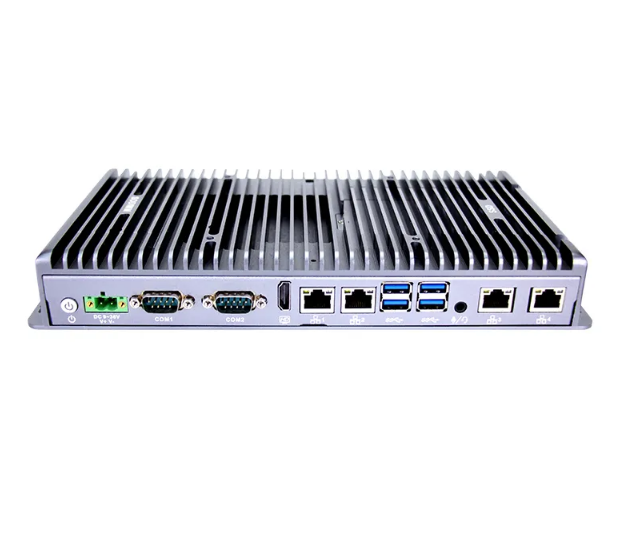
Rugged Design for Demanding Environments
Industrial computer manufacturers prioritize durability to ensure reliable operation in harsh settings—whether on factory floors, in outdoor kiosks, or aboard moving vehicles. Systems are engineered to withstand dust, water, extreme temperatures, shock, and vibration without compromising performance.
IP65/NEMA4 Sealing and Fanless Thermal Management
Enclosures meet IP65 or NEMA4 standards, providing complete protection against dust ingress and low-pressure water jets. This sealing prevents contaminants from reaching sensitive internal components. To complement this, fanless thermal management eliminates moving parts prone to failure or clogging. Heat dissipates via conduction through large, chassis-integrated heatsinks—delivering silent, maintenance-free cooling ideal for clean rooms and noise-sensitive environments. This passive approach also reduces power draw, a key advantage in energy-constrained edge deployments. By combining sealed enclosures with efficient conductive cooling, manufacturers extend product lifetime and minimize unplanned downtime.
Wide-Temperature Operation (−40°C to 70°C) and Shock/Vibration Resistance
Components—including CPUs, memory, and storage—are selected for guaranteed operation across −40°C to 70°C ambient temperatures, enabling stable boot and function in freezer tunnels or near industrial furnaces. System-level thermal design incorporates wide-temperature-rated capacitors and optimized conductive pathways to withstand rapid thermal cycling. For mechanical resilience, PCBs use ruggedized mounting, shock-absorbing gaskets, and secure cable retention. Units are validated per MIL-STD-810G for drop, random vibration, and constant acceleration—ensuring survival in transport, oil and gas, and defense applications. This dual focus on thermal and mechanical robustness delivers uninterrupted operation where environmental stability cannot be assumed.
High-Performance, Edge-Ready Computing Platforms
Industrial edge computers deliver computational resilience where latency, reliability, and physical constraints matter most—processing data locally to enable real-time control, analytics, and AI inference without cloud dependency.
Intel Core i7-6700TE and NVIDIA Jetson Integration for Real-Time AI Workloads
Platforms integrate high-efficiency processors like the Intel Core i7-6700TE with embedded AI accelerators such as NVIDIA Jetson modules. This pairing balances multi-threaded general-purpose computing with parallel processing for convolutional neural networks and real-time inferencing—powering predictive maintenance, visual quality inspection, and autonomous decision-making at the edge. Thermal and power optimization is built-in, allowing sustained performance in compact, fanless enclosures deployed on manufacturing lines, in logistics hubs, or in field-mounted equipment.
Industrial I/O Flexibility: Multi-Protocol Support, Watchdog Timers, and High-Brightness Touch
Robust I/O enables seamless integration across heterogeneous industrial ecosystems. Native support for Modbus, CAN bus, PROFINET, and Ethernet/IP allows direct connection to sensors, PLCs, and legacy machinery. Integrated watchdog timers automatically recover from software hangs—critical in unattended or remote deployments. High-brightness touchscreens (≥1000 nits) remain legible in direct sunlight, supporting mobile operator terminals and outdoor kiosks. Additional features include multiple isolated serial ports, digital I/O channels, and expansion slots for vision capture cards or 4G/LTE modems—transforming the system into a localized control and analytics hub.
Long-Term Reliability and Regulatory Compliance
Industrial computing demands longevity, safety, and regulatory alignment—not just at launch, but across decades of deployment.
10–15 Year Lifecycle Support, UL/EN 50155/RoHS Certifications, and Mechanical Consistency
Manufacturers commit to 10–15 year minimum hardware availability, backed by long-term silicon roadmaps like Intel’s Embedded Roadmap extending supply continuity through 2035. This eliminates costly requalification in mission-critical infrastructure. Mechanical consistency—precise alignment of mounting holes, port locations, and form factors—enables true drop-in replacements years later. Certifications validate compliance across domains:
- UL/EN 50155 confirms shock/vibration resilience per railway Grade 3 requirements
- RoHS compliance restricts hazardous substances including cadmium, mercury, and lead
- Class 3 bend-testing verifies structural integrity for telecom and mobile transport applications
Application-Specific Customization from Industrial Computer Manufacturers
Tailored solutions bridge the gap between standardized hardware and industry-specific workflows—reducing integration friction and extending operational ROI.
Modular Architecture: CMi/CFM Modules, Riser Cards, and Scalable Decks for Smart Factories
Modular design centers on interchangeability and future-readiness. CMi (Computer Module Interface) and CFM (Custom Function Module) standards let users upgrade core compute, memory, or I/O independently—without redesigning the full platform. Riser cards expand PCIe bandwidth for vision systems, motion controllers, or 5G connectivity. Scalable decks add layers for storage, power, or specialized interfaces—supporting evolving Industry 4.0 needs. This architecture accelerates deployment, simplifies field upgrades, and preserves mechanical footprints while enabling rapid adoption of AI accelerators, sensor bridges, or real-time control modules.