 EN

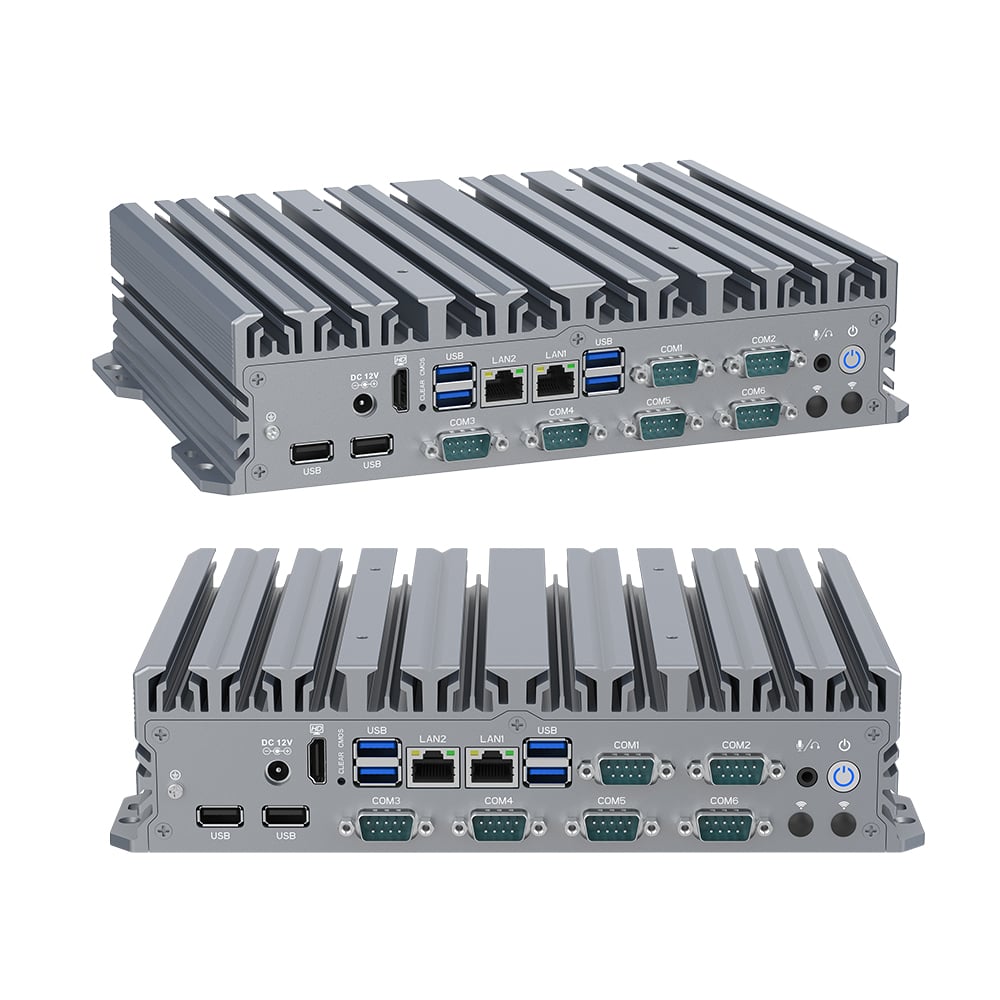
Fanless Industrial PC: Definition, Core Design Principles, and Environmental Hardening
A fanless industrial PC is a sealed computing platform that removes the rotating cooling fan and relies on passive heat transfer to maintain reliable operation in demanding environments.
Passive Thermal Management: Heatsinks, Conduction Cooling, and Wide Temperature Range (-40°C to 85°C)
Passive cooling eliminates mechanical fans in favor of conduction, heat pipes, and natural convection. Heat from the processor, chipset, and power circuitry transfers through thermal interface materials into aluminum or copper heatsinks. Heat pipes or vapor chambers move thermal load to the external chassis, where finned surfaces dissipate heat via natural convection and radiation. With no intake vents, dust, moisture, and contaminants cannot enter the enclosure—enhancing reliability in harsh settings like outdoor kiosks, cold storage facilities, and desert solar installations. Large surface-area heatsinks paired with low-power embedded processors keep junction temperatures within safe limits at high ambient temperatures, while the sealed design minimizes condensation risk during thermal cycling in sub-zero conditions. Crucially, removing fan bearings and motor windings eliminates a dominant wear-out mechanism: a 2023 reliability review found fan bearing failure becomes the leading cause of downtime after ~25,000 hours of continuous operation, whereas passive heatsinks have no equivalent degradation pathway.
Industrial-Grade Resilience: IP67/IP65 Ratings, Shock/Vibration Resistance (IEC 60068-2), and Corrosion Protection
A sealed chassis and rugged internal mounting deliver industrial-grade resilience. IP65 and IP67 ratings ensure complete dust-tightness; IP65 resists low-pressure water jets, while IP67 withstands temporary immersion—making these systems viable for food processing washdowns, marine deployments, and outdoor digital signage. For mechanical durability, units are validated to IEC 60068-2 test profiles—including random vibration (5 Hz to 500 Hz) and shock pulses up to 50 g. SSDs are secured using locking connectors or board-level mounting to prevent disconnection under sustained vibration. Corrosion resistance comes from anodized aluminum or stainless-steel enclosures, conformal-coated PCBs, and sealed cable glands. The absence of cooling vents also blocks salt spray and chemical vapors from reaching internal boards. High-durometer silicone or EPDM gaskets maintain sealing integrity across the full operating temperature range. According to 2023 deployment reports, sealed fanless systems in coastal and high-humidity sites showed significantly fewer corrosion-related failures than actively cooled PCs with exposed vents.
Enhanced Reliability and Uptime: Why Fanless Industrial PCs Excel in 24/7 Critical Operations
Removing the cooling fan eliminates the most common mechanical failure point in conventional computers—directly protecting uptime in continuous production environments.
Eliminating Failure Points: How Removing Fans Increases MTBF by 30–50% (IEC 60068-2 Validation)
Traditional PCs rely on fans that wear out, clog, and seize due to bearing degradation, lubricant dry-out, and blade fatigue—triggering overheating and unplanned shutdowns. By eliminating fans entirely, passive cooling systems remove this failure mode. Independent validation under IEC 60068-2 shock and vibration testing confirms that fanless industrial PC designs achieve 30–50% higher mean time between failures (MTBF) than comparable fan-cooled models. Solid-state drives further reduce mechanical stress, while secure heatsink mounting ensures thermal performance remains stable under dynamic loads. A 2025 manufacturing automation report found rugged fanless systems reduced unexpected shutdowns by ~72% compared with consumer-grade PCs—supporting an estimated 99.95% uptime over ten years in factory automation. Fewer moving components translate directly to less corrective maintenance and greater stability for SCADA, process control, and other mission-critical applications.
Dust, Debris, and Contaminant Immunity: Essential for Factory Floors, Mining, and Outdoor Deployments
Dust, metal shavings, moisture, and airborne particulates rapidly degrade fan performance and block airflow paths. Sealed IP-rated enclosures eliminate these contamination vectors entirely. In mining operations, silica-laden coal dust can coat internal components and choke vents; in outdoor kiosks, rain, pollen, and windblown debris accelerate fan wear. Without vents, fanless systems avoid all such entry points. Conduction-based cooling moves heat through the chassis—not through dirty air—so corrosive gases and abrasive particles never reach sensitive motherboard components. This preserves thermal headroom and prevents throttling. Maintenance crews avoid routine filter cleaning, fan replacement, and internal vacuuming—extending service intervals and sustaining stable 24/7 operation even in poor air quality environments.
Silent, Efficient, and Space-Optimized: Operational Advantages of Fanless Industrial PCs
Zero-Noise Operation: Enabling Deployment in Medical Imaging, Audio Production, and Cleanroom Environments
Fanless industrial PCs generate virtually no audible noise or mechanical vibration—critical in acoustically sensitive environments. Heat moves from the CPU through internal heat spreaders and an extruded aluminum chassis acting as a passive heatsink, while solid-state storage eliminates additional moving parts. In medical imaging, fan-induced vibration can blur MRI or CT scans and disrupt patient comfort. Audio production studios benefit from a lower noise floor during recording and mixing. Cleanrooms gain from reduced air turbulence and particle circulation—both of which active cooling fans introduce. The result is silent, stable computing without compromising environmental integrity.
Energy Efficiency and Compact Form Factors: DIN-Rail, Panel-Mount, and Ultra-Slim Designs for Edge AI and Embedded Systems
Passive cooling enables lower power draw and smaller footprints. Without fans consuming 3–10 W continuously, total system energy demand drops—permitting sealed, compact deployments in tight spaces such as control cabinets, vehicle carriages, and integrated automation equipment. Common form factors include DIN-rail mounting for machine-level control, panel-mount designs for operator terminals, and ultra-slim enclosures optimized for edge AI and embedded applications. These configurations reduce airflow clearance requirements and simplify integration where space is constrained. Lower power consumption also supports battery- or solar-powered operation in remote locations. The outcome is a flexible, energy-efficient platform that fits seamlessly into industrial infrastructure—without redesigning thermal management around a fan.
Total Cost of Ownership: Lower Lifecycle Costs and Simplified Maintenance for Fanless Industrial PCs
Total cost of ownership (TCO) for a fanless industrial PC is measured over its operational lifespan—not at initial purchase. Fan-cooled systems deployed in dusty or high-vibration environments often require recurring fan replacements, filter changes, and internal cleaning—adding labor, spare parts, and downtime costs.
Independent lifecycle analyses indicate fanless industrial PCs routinely remain in service for 10+ years, compared with 3–5 years for fan-cooled equivalents under similar industrial conditions (2023). This extended service life spreads acquisition cost over more productive years and reduces replacement frequency. Lower mechanical failure rates cut emergency service calls, spare parts inventory, and unplanned line stoppages. Eliminating fan motors also lowers continuous energy draw—delivering measurable savings across multi-unit fleets.
Maintenance simplifies dramatically: there are no fan bearings to wear out, no filters to replace, and no dust buildup inside the chassis. In 24/7 production settings—where every minute of downtime impacts revenue—the lower TCO of a fanless industrial PC often offsets its higher upfront price within the first two to three years of operation.
FAQs
Q: What is a fanless industrial PC?
A: A fanless industrial PC is a sealed computing platform that eliminates the need for rotating cooling fans and relies on passive heat transfer methods for cooling, making it ideal for demanding and harsh environments.
Q: How does a fanless industrial PC manage heat without fans?
A: It uses passive cooling mechanisms such as heatsinks, heat pipes, and natural convection to transfer heat away from components and dissipate it via the external chassis.
Q: What are IP65 and IP67 ratings?
A: These ratings denote the degree of protection against dust and water. IP65 ensures dust-tightness and protection against low-pressure water jets, while IP67 supports temporary immersion in water.
Q: Why are fanless industrial PCs preferred in critical operations?
A: They eliminate the most common mechanical failure point—cooling fans—leading to higher reliability, lower maintenance, and increased uptime, especially in 24/7 operations.
Q: What industries benefit most from fanless industrial PCs?
A: Industries such as manufacturing, mining, outdoor kiosks, medical imaging, audio production, and cleanroom environments benefit significantly due to their resilience, zero-noise operation, and low maintenance requirements.
Q: How do fanless systems reduce total cost of ownership (TCO)?
A: Fanless systems have an extended service life, lower mechanical failure rates, and minimal maintenance needs, offsetting their higher upfront cost within two to three years of operation.
Table of Contents
- Fanless Industrial PC: Definition, Core Design Principles, and Environmental Hardening
- Enhanced Reliability and Uptime: Why Fanless Industrial PCs Excel in 24/7 Critical Operations
- Silent, Efficient, and Space-Optimized: Operational Advantages of Fanless Industrial PCs
- Total Cost of Ownership: Lower Lifecycle Costs and Simplified Maintenance for Fanless Industrial PCs
- FAQs