 EN
EN

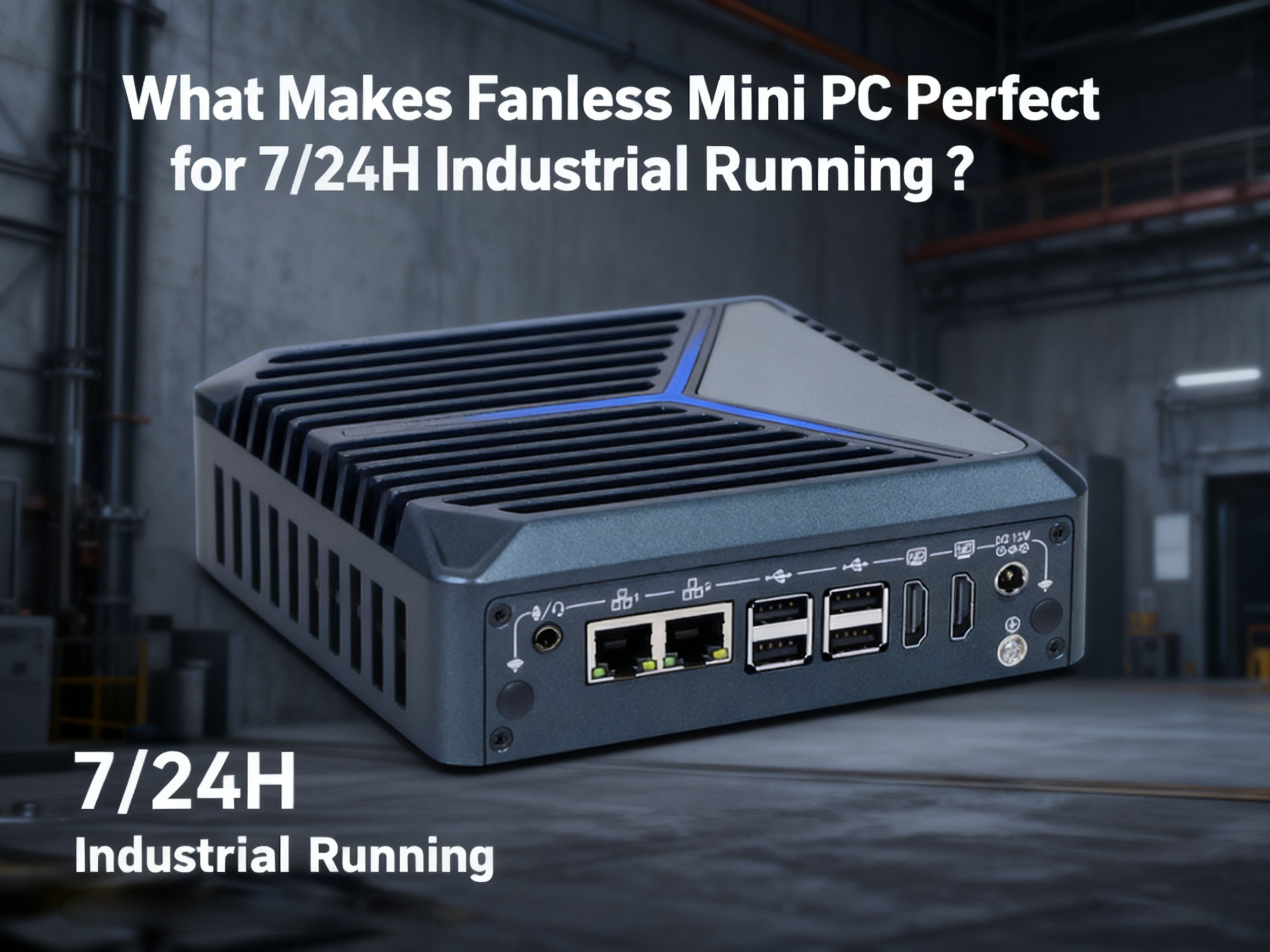
In the fast-paced world of industrial automation, manufacturing, and IoT operations, uninterrupted 7/24H performance is not just a preference but a critical requirement for every piece of computing hardware. Traditional fan-cooled computers often fail to meet this demand in industrial settings, plagued by dust buildup, mechanical breakdowns, and frequent downtime. The fanless mini PC, however, has emerged as the ultimate solution for round-the-clock industrial running, combining a compact form factor with a passive cooling design that addresses the unique challenges of harsh industrial environments. More than just a hardware choice, the fanless mini PC is engineered with industrial-grade durability, energy efficiency, and reliable performance at its core—making it uniquely suited to the nonstop demands of factory floors, logistics hubs, and industrial control systems. Below, we explore the key design and functional attributes that make the fanless mini PC the perfect fit for 7/24H industrial operation.
Passive Cooling Design Eliminates Mechanical Failure Points
The defining feature of a fanless mini PC—and the cornerstone of its 7/24H reliability—is its passive cooling system, which replaces traditional mechanical fans with heat sinks and thermal conduction materials to dissipate heat. Industrial environments are filled with dust, debris, and particulate matter, which quickly clog fan filters and cause fan motors to burn out or seize up in cooled systems. This mechanical failure is the single biggest cause of unplanned downtime for fan-based computers in industrial settings. A fanless mini PC has no moving parts, removing this critical failure point entirely. Heat is dispersed evenly through the device’s rugged chassis, ensuring consistent cooling even during continuous operation, and the sealed design prevents dust and moisture from entering internal components. This means the fanless mini PC can run nonstop for months or even years without the need for fan maintenance, filter cleaning, or component replacements—an indispensable advantage for industrial operations that cannot afford costly downtime.
Industrial-Grade Ruggedness for Harsh Operating Conditions
Fanless mini PCs are not just fan-free—they are built with industrial-grade ruggedness that aligns with the rigors of 7/24H industrial running. Every component, from the motherboard to the processor and casing, is selected and tested for durability in harsh environments, including extreme temperatures, constant vibration, and physical shock common in manufacturing and logistics. Most fanless mini PCs feature a reinforced metal chassis that offers vibration resistance, a critical feature for deployment on factory machinery, conveyor belts, or mobile industrial carts where constant movement would damage consumer-grade hardware. They also operate seamlessly across a wide temperature range, far beyond the limits of standard computers, meaning they perform reliably in unheated factory bays or warm control rooms without thermal throttling or system crashes. Paired with a DC 12V stable power supply, fanless mini PCs also resist voltage fluctuations that are common in industrial power grids, further ensuring uninterrupted 7/24H performance.
Energy Efficiency and Low Heat Output for Sustained Operation
7/24H industrial running demands hardware that is energy-efficient and produces minimal heat—two traits that fanless mini PCs deliver in abundance. Fanless mini PCs are paired with low-power, high-performance processors such as Intel N-series, J-series (J1900, J6412), and even 12th/14th Gen Intel Core Ultra chips, all engineered to deliver robust computing power with ultra-low power consumption. Unlike fan-cooled systems that waste energy on fan motor operation, the passive cooling of a fanless mini PC uses no additional power for temperature regulation, reducing overall energy use by a significant margin. This low power draw not only cuts down on industrial energy costs but also results in minimal heat output. Even during continuous 7/24H operation, the device generates little excess heat, eliminating the need for additional cooling systems and reducing the risk of thermal overload. For industrial facilities with hundreds of computing devices running round the clock, this energy efficiency translates to substantial long-term cost savings and a smaller environmental footprint.
Compact Form Factor and Seamless Industrial Integration
Industrial spaces are often space-constrained, with computing hardware needing to fit into tight machinery enclosures, wall-mounted control panels, or distributed edge locations. The fanless mini PC’s ultra-compact size addresses this challenge perfectly, with a small footprint that allows for easy integration into existing industrial infrastructure without sacrificing performance. Its compact design also means it can be deployed in decentralized edge locations—such as production line workstations or warehouse inventory points—where larger computers simply cannot fit, enabling real-time data processing and control for 7/24H industrial IoT operations. Additionally, fanless mini PCs come equipped with a full suite of industrial-grade connectivity ports, including multiple LAN, COM, and USB ports, ensuring seamless integration with PLCs, sensors, industrial robots, and other automation equipment. This connectivity, paired with their small size, makes fanless mini PCs a flexible, scalable solution for industrial operations that require distributed computing for nonstop performance.
High-Performance Processing for Uninterrupted Industrial Workloads
While fanless mini PCs are designed for durability and efficiency, they do not compromise on processing power—an essential factor for 7/24H industrial running that involves complex workloads like real-time data analysis, machine control, and IoT data collection. Modern fanless mini PCs are powered by Intel Core i3, i5, i7, and 12th/14th Gen Core Ultra processors, delivering the computing power needed to run multiple industrial applications simultaneously without lag or system slowdown. Whether processing sensor data from a production line, controlling automated machinery, or managing a network of industrial IoT devices, the fanless mini PC handles these workloads with ease for 24 hours a day, 7 days a week. Many models also offer expandable storage and removable RAM/SSD, allowing businesses to upgrade performance as their industrial workloads grow—ensuring the fanless mini PC remains a reliable workhorse for long-term 7/24H operation.
In conclusion, the fanless mini PC is purpose-built for 7/24H industrial running, with a passive cooling design that eliminates downtime, industrial-grade ruggedness that withstands harsh conditions, energy efficiency that supports sustained operation, and compact scalability that fits every industrial space. Unlike traditional fan-cooled computers, it addresses every core challenge of round-the-clock industrial computing, delivering the reliability, performance, and low maintenance that modern industrial operations demand. For businesses looking to power their 7/24H industrial automation, IoT, and control systems with a computing solution that never quits, the fanless mini PC is the definitive choice.
Table of Contents
- Passive Cooling Design Eliminates Mechanical Failure Points
- Industrial-Grade Ruggedness for Harsh Operating Conditions
- Energy Efficiency and Low Heat Output for Sustained Operation
- Compact Form Factor and Seamless Industrial Integration
- High-Performance Processing for Uninterrupted Industrial Workloads