 EN
EN

The Critical Role of Industrial PCs in Modern Factory Automation
Phenomenon: The Rise of Smart Manufacturing and Industry 4.0
More than three quarters of manufacturers are jumping on board with smart factory projects these days just to keep up with what Industry 4.0 requires. According to some recent numbers from 2024, this trend has pushed industrial PC adoption rates up by nearly 30% each year. Why? Well, factories need computers that can take a beating really. These machines have to handle super hot environments, constant shaking around, and run non stop day after day while processing all that live data coming in from sensors and robots everywhere. Regular office computers just won't cut it here. Industrial PCs actually make everything work together smoothly across different systems like PLCs, SCADA setups, and actual production equipment. Without them, those automated processes would fall apart pretty quickly.
Principle: How Industrial PCs Enable Real-Time Process Control
Industrial PCs get down to sub-millisecond response times when they combine fieldbus protocols such as PROFINET and EtherCAT with deterministic OSes. What does this mean in practice? These systems can handle over fifty axes of servo motion at once while managing vision guided robots and running quality checks all at the same time. According to a recent benchmark from the automation sector in 2023, these industrial PCs cut down on production line delays by around 84 percent compared to old school commercial PCs that have been retrofitted. The real world benefit? Everything stays synchronized even during those fast paced packaging lines and complex assembly operations where timing matters most.
Case Study: Automotive Assembly Line Automation Using Industrial PCs
An automotive factory in North America put IPCs at the heart of their 12 stage assembly process, managing to keep operations running almost constantly with just 0.02% downtime across 18 months straight. These systems handle around 2.3 terabytes worth of sensor information each day, fine tuning how much force the welding robots apply while also figuring out the best paths for those little AGVs that move parts around the floor. According to reports from last year's smart manufacturing studies, this setup cut down on defective products by about 40 percent and brought energy usage down nearly 18%. The real secret sauce here seems to be these IPCs allowing for predictive maintenance approaches that spot problems before they actually happen.
Trend: Integration of IIoT and Edge Computing with Industrial PCs
Today's industrial PCs come equipped with edge computing capabilities that handle around two thirds of factory data right at the source, cutting down on reliance on cloud services by almost half according to the latest Industrial Edge Computing Report. These systems not only power up smart quality checks using artificial intelligence but also keep things secure thanks to TPM 2.0 encryption built directly into the hardware. The best setups out there are pairing OPC UA protocols with what's called time sensitive networking or TSN for short. This combination makes sure critical safety information gets priority treatment first, especially important stuff coming from those collision avoidance sensors and emergency stop buttons throughout manufacturing plants.
Strategy: Deploying Industrial PCs as Central Hubs in Automation Networks
System integrators recommend a layered IPC architecture:
- Control Layer: Fanless IPCs with DIN-rail mounting for machine-level PLC coordination
- Edge Layer: GPU-accelerated IPCs handling vision systems and digital twins
- Enterprise Layer: Rack-mounted IPCs aggregating production data for ERP integration
This approach reduced integration costs by 31% in a recent large-scale food processing automation project, demonstrating IPCs’ scalability across batch-processing and continuous manufacturing environments.
## Industrial PC vs Commercial PC: Why Standard Computers Fail in Factories

### Key Differences in Design and Intended Use Environment
Industrial PCs feature fanless cooling systems, conformal-coated circuit boards, and hardened steel enclosures rated IP65 or higher—protections absent in commercial PCs designed for climate-controlled offices. Where consumer-grade hardware operates within 0°C to 40°C, industrial models function reliably from -20°C to 70°C, with 50,000+ hour MTBF (Mean Time Between Failures) ratings compared to 5,000—10,000 hours for office PCs.

| Feature                | Industrial PC               | Commercial PC               |
|------------------------|-----------------------------|----------------------------|
| Operating Temperature  | -20°C to 70°C               | 0°C to 40°C                |
| Shock Resistance       | 50G operational             | 5G non-operational         |
| MTBF                   | 50,000+ hours              | <10,000 hours              |
| Lifespan               | 7-10 years                 | 2-3 years                 |

### Failure Rates of Commercial PCs Under Industrial Stress Conditions
Ponemon Institute data reveals commercial PCs suffer 83% failure rates within 18 months when exposed to factory conditions like 65dB vibrations and airborne particulates. In contrast, industrial PCs maintain 97.8% uptime in identical environments according to 2023 manufacturing reliability studies.

### Total Cost of Ownership: Reliability Over Time Favors Industrial PCs
While industrial PCs cost 3—5x more upfront, their 10-year lifespan versus commercial PCs' 3-year replacement cycle yields 34% lower TCO. A 2025 industrial computing report shows factories using rugged PCs save $740k annually in avoided downtime costs and maintenance labor compared to commercial PC deployments.
Ruggedness, Reliability, and Durability in Harsh Industrial Environments
Industrial PCs face extreme operational challenges unmatched in commercial settings. Their success in automation hinges on three critical engineering pillars: environmental protection, mechanical resilience, and thermal stability.
Environmental Protection: IP Ratings, Dust, and Water Resistance
Certified IP65/66-rated enclosures enable industrial PCs to operate in particulate-heavy metalworking facilities and high-humidity food processing plants. Unlike consumer-grade devices, these systems use sealed gaskets and corrosion-resistant alloys to prevent ingress-related failures, which caused $740k in downtime costs per facility annually (TAICENN 2023).
Temperature Range Tolerance: Operation from -20°C to 70°C
Engineered for thermal extremes, industrial PCs employ wide-temperature components and passive cooling systems validated through 5,000+ thermal cycle tests. This allows uninterrupted operation in freezer warehouses (-20°C) and near foundry equipment (70°C), where standard computers fail within 72 hours.
Vibration and Shock Resistance in High-Motion Production Areas
Industrial PCs withstand 5Grms vibration loads using MIL-STD-810G compliant shock-mounted SSDs, reinforced PCIe slots with retention clamps, and vibration-dampening chassis designs. These features prove critical in stamping presses and automotive assembly lines where impacts exceed 50G forces.
Fanless Designs and Solid-State Storage Enhancing System Stability
By eliminating moving parts, fanless industrial PCs achieve <0.5% failure rates in 5-year deployments compared to 12% in forced-air systems. Conformal-coated PCBs and industrial-grade SATA DOM modules prevent data loss during sudden power disruptions, maintaining <10ms response times in PLC networks.
Powerful Connectivity and I/O Flexibility for Seamless Equipment Integration
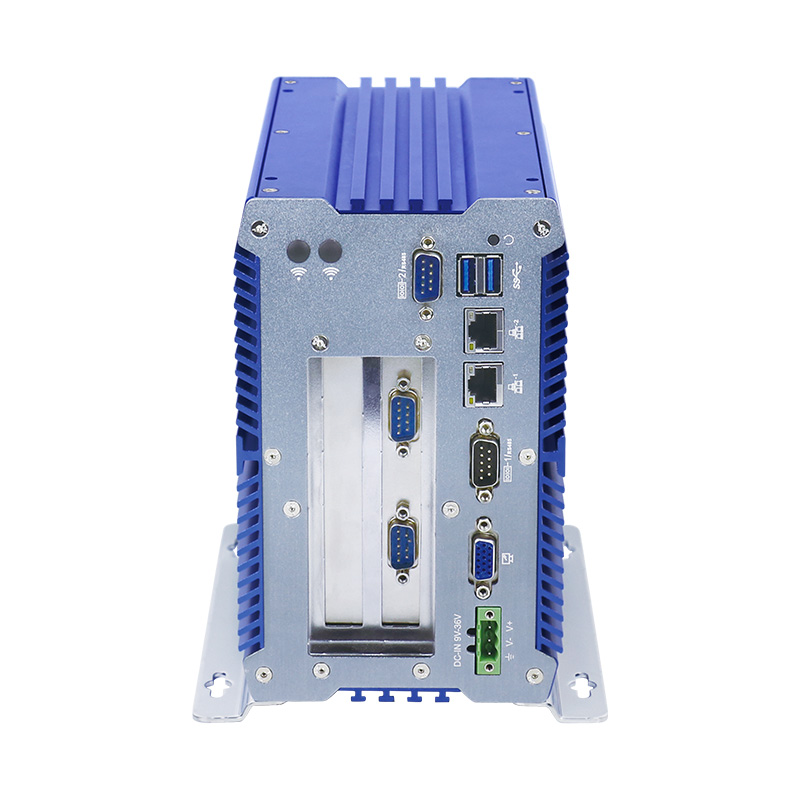
Support for Legacy Systems and Multiple Communication Protocols Industrial PCs serve as connectors between old and new automation systems. They keep working with older equipment while also handling newer communication standards such as OPC UA, Modbus, and EtherCAT. Take one popular industrial PC for example it has four Gigabit Ethernet connections plus six COM ports that support RS-232 and RS-485 signals. This setup lets factories run their 20 year old PLCs right next to cutting edge AI vision systems, all without tearing out existing infrastructure and spending big bucks on replacements. The ability to mix old and new hardware saves money and keeps operations running smoothly during transitions.
High-Density I/O Options for Sensors, Robots, and Controllers
Modern industrial PCs provide up to 48 digital I/O points and 16 analog channels in compact form factors, enabling direct connections to:
- 15+ axis servo drives for precision robotics
- Thermocouples and pressure sensors with ±0.1°C accuracy
- Safety relays and emergency stop circuits
Industrial PCs with under 1 millisecond response times keep data flowing smoothly between over 500 factory devices at once. Real time processing makes all the difference on those fast moving packaging lines that can handle around 12 thousand units every hour, not to mention CNC machining operations where getting positioning right down to 5 micrometers matters a lot. These systems have parallel processing capabilities that manage about 8 gigabytes of sensor data per hour, yet still maintain those incredibly fast control loops needed for hydraulic actuators and pneumatic valves throughout the plant. Manufacturers rely on this kind of performance to maintain production quality without slowdowns when things get busy on the shop floor.
Long-Term Expandability and Support for Future-Proof Automation Systems
Industrial PCs form the backbone of sustainable manufacturing automation by combining upgradeable hardware architectures with extended lifecycle support. Their design philosophy directly addresses industry's twin demands for technological adaptability and operational continuity.
Modular Design Allowing Future Hardware Upgrades
Industrial PC systems employ modular architectures that enable component-level upgrades without full system replacements. Standardized expansion slots and tool-free access panels allow manufacturers to integrate new processors, I/O modules, or connectivity options as production needs evolve, protecting investments in existing automation infrastructure.
Long-Term Availability of Components and Firmware Updates
Leading suppliers guarantee 7—10 year availability cycles for industrial PC components, with firmware updates maintaining compatibility as communication protocols evolve. This extended support window ensures consistent spare parts access and software updates—a critical advantage over consumer-grade hardware's typical 2—3 year lifecycle.
Avoiding Obsolescence in Critical Manufacturing Systems
By incorporating backward-compatible expansion interfaces and legacy protocol support, industrial PCs maintain functionality with decades-old equipment while accommodating modern sensors and controllers. This interoperability prevents costly system-wide upgrades when introducing new production line components.
Controversy Analysis: Short Product Cycles vs. Industrial Longevity Needs
The consumer technology sector's 18—24 month upgrade cycles clash with industrial automation's 10+ year lifecycle requirements. Industrial PCs resolve this tension through hot-swappable component designs that accept contemporary computing hardware within proven industrial-grade chassis and power systems.
Enabling Advanced Applications: Robotics, IIoT, and Predictive Maintenance
Modern industrial PCs provide the computational horsepower needed for real-time robotics control and IIoT data aggregation. Implementation of AI-driven predictive maintenance models has reduced unplanned equipment downtime by 35% in continuous manufacturing environments through edge computing-enabled condition monitoring.
FAQs
What is an Industrial PC?
An Industrial PC (IPC) is a computer designed to operate in harsh environments such as factories, capable of withstanding extreme temperatures, vibrations, and dust.
How do Industrial PCs differ from Commercial PCs?
Industrial PCs are designed with rugged components to handle extreme conditions, whereas commercial PCs are meant for office environments with limited temperature and dust exposure.
Why are Industrial PCs important in automation?
Industrial PCs are crucial for integrating and managing automated systems in factories, ensuring real-time process control and reducing downtime.
What are the main benefits of integrating IIoT with Industrial PCs?
IIoT integration with industrial PCs enhances data processing at the edge, reduces cloud dependency, and improves real-time analysis and system security.
Table of Contents
-
The Critical Role of Industrial PCs in Modern Factory Automation
- Phenomenon: The Rise of Smart Manufacturing and Industry 4.0
- Principle: How Industrial PCs Enable Real-Time Process Control
- Case Study: Automotive Assembly Line Automation Using Industrial PCs
- Trend: Integration of IIoT and Edge Computing with Industrial PCs
- Strategy: Deploying Industrial PCs as Central Hubs in Automation Networks
- Ruggedness, Reliability, and Durability in Harsh Industrial Environments
- Powerful Connectivity and I/O Flexibility for Seamless Equipment Integration
-
Long-Term Expandability and Support for Future-Proof Automation Systems
- Modular Design Allowing Future Hardware Upgrades
- Long-Term Availability of Components and Firmware Updates
- Avoiding Obsolescence in Critical Manufacturing Systems
- Controversy Analysis: Short Product Cycles vs. Industrial Longevity Needs
- Enabling Advanced Applications: Robotics, IIoT, and Predictive Maintenance
- FAQs