 EN
EN

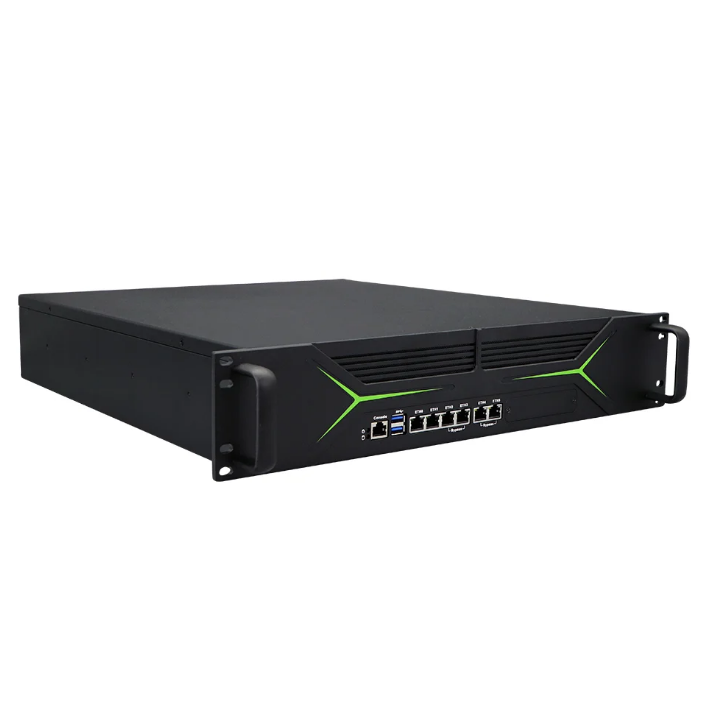
Walk into any modern data center, and the rack landscape tells a story of trade-offs. The 1U server might pack compute into minimal space, but the 2U server occupies a fundamentally different position in the infrastructure hierarchy. At 3.5 inches (88.9 mm) of vertical rack space—exactly double the 1U standard defined by the EIA-310 specification—the 2U chassis opens up capabilities that simply cannot exist in slimmer footprints.
The extra height translates directly into practical advantages. Larger heatsinks handle higher-TDP processors without throttling. Deeper chassis accommodate full-height, full-length expansion cards. More internal volume means more drive bays, better airflow, and quieter fan operation. A 2U server typically supports anywhere from 8 to 24 drive bays, compared to the 4 to 10 found in most 1U systems. This isn't just about storage capacity—it's about architectural flexibility.
Consider what happens when a deployment requires both high-core-count CPUs and multiple GPU accelerators. The 1U chassis simply runs out of room. The 2U form factor, by contrast, can host dual processors, multiple PCIe Gen5 slots, and substantial storage arrays all in one enclosure. That capability changes the conversation from "what can we fit?" to "what can we build?"
Where Network Scalability Actually Begins
Network scalability in a 2U server starts with physical expansion capacity. A typical 2U platform offers anywhere from five to eight PCIe slots, depending on the motherboard and riser configuration. Those slots aren't just for storage controllers—they're the on-ramp for network bandwidth.
Modern 2U servers can accommodate up to eight expandable NIC modules, supporting a theoretical maximum of 66 LAN ports across copper, fiber, and bypass configurations at speeds from 1G to 40G and beyond. That kind of port density isn't necessary for every use case, but for network appliances, edge aggregation points, and virtualization hosts, it's the difference between a server that works today and one that can scale for tomorrow.
The numbers tell a clear story. Industry data shows that GPU scale-out bandwidth requirements have jumped from 200G to 400G to 800G in recent years. Traditional CPU-based compute can't keep pace with that trajectory without the physical infrastructure to support it. The 2U form factor provides that infrastructure—not just in theory, but in deployed systems handling real production traffic.
What the Extra Rack Unit Buys You
| Capability | 1U Server | 2U Server |
|---|---|---|
| Vertical Space | 1.75" (44.45 mm) | 3.5" (88.9 mm) |
| Typical Drive Bays | 4–10 | 8–24 |
| PCIe Slots | 1–2 low-profile | 5–8 full-height |
| Cooling | High-velocity fans | Larger, quieter fans |
| Redundant PSU Support | Limited | Standard (1+1 or 2+2) |
The table above distills the practical differences. But the real value shows up in operational metrics. A 2U server with redundant, hot-swappable power supplies can sustain hardware maintenance without service interruption. Dual 1600W to 2600W Titanium-level PSUs provide both capacity and efficiency, with load-sharing and automatic failover. For mission-critical environments, that redundancy isn't a luxury—it's a requirement.
A Real-World Case: The Aggregation Layer Bottleneck
A telecommunications provider in the Midwest ran into a familiar problem about eighteen months ago. Their edge aggregation sites were built around 1U appliances that had been adequate for 10G uplinks but were struggling with the transition to 25G and 100G transport. The chassis couldn't accommodate the larger NICs. Cooling was marginal. Power supplies were single and non-redundant.
The engineering team evaluated a shift to 2U platforms. The new chassis supported dual processors, six PCIe Gen4 slots, and redundant hot-swap power. More importantly, the larger thermal envelope allowed the system to run the high-bandwidth NICs without throttling—a problem that had plagued the previous generation. Within six months, the provider had migrated thirty-seven aggregation sites. Uptime at those locations improved from 99.91% to 99.97%. The bottleneck wasn't the network anymore; it was the provisioning pipeline.
That experience isn't unique. Similar patterns show up in financial services colocation, research computing clusters, and enterprise virtualization farms. The 2U form factor doesn't solve every problem, but it removes a surprisingly large number of them.
When Density Isn't the Only Priority
Rack density remains a legitimate concern. A standard 42U rack holds 42 1U servers versus 21 2U servers. For organizations where floor space is the primary constraint, that math favors the smaller footprint. But density isn't the only variable in the equation.
Power consumption per rack has shifted dramatically. Data center power densities that once averaged 5–10 kW per rack now routinely exceed 20–40 kW in AI inference and HPC deployments. At those levels, cooling efficiency and component reliability matter as much as unit count. A 2U server with larger, slower-turning fans moves more air with less noise and lower failure rates than a 1U system relying on high-speed, smaller-diameter fans.
The thermal advantages compound over time. Fan failures in high-density 1U deployments are a known maintenance headache. The 2U form factor reduces fan count per unit of compute while improving overall airflow—a trade-off that often delivers better total cost of ownership over a three-to-five-year hardware lifecycle.
Planning for the Next Bandwidth Upgrade
Network scalability isn't just about what a server supports today. It's about whether the chassis can accommodate tomorrow's requirements without a forklift upgrade. PCIe Gen5 slots handle current-generation NICs and will support the next generation as well. Redundant power supplies with sufficient headroom absorb increased load from additional cards. Drive bays that support both SATA and NVMe provide storage flexibility as workloads evolve.
The 2U server sits at a sweet spot in this planning horizon. It offers enough expansion capacity to handle multi-year growth while maintaining a footprint that fits in standard 19-inch racks. It doesn't promise infinite scalability—no hardware does—but it provides a platform that can adapt to changing requirements without requiring a complete infrastructure redesign.
For organizations that have learned the hard way that "good enough for now" rarely survives a budget cycle, the 2U form factor offers a pragmatic middle ground between the density of 1U and the sprawl of 4U or larger chassis.
XSK manufactures 2U server platforms with a focus on thermal management, redundant power delivery, and expansion flexibility—the three pillars that determine whether a server can scale with network demands over its service life. The company's engineering approach prioritizes real-world reliability over theoretical specifications, a distinction that becomes apparent when systems are deployed at scale in production environments.