 EN
EN

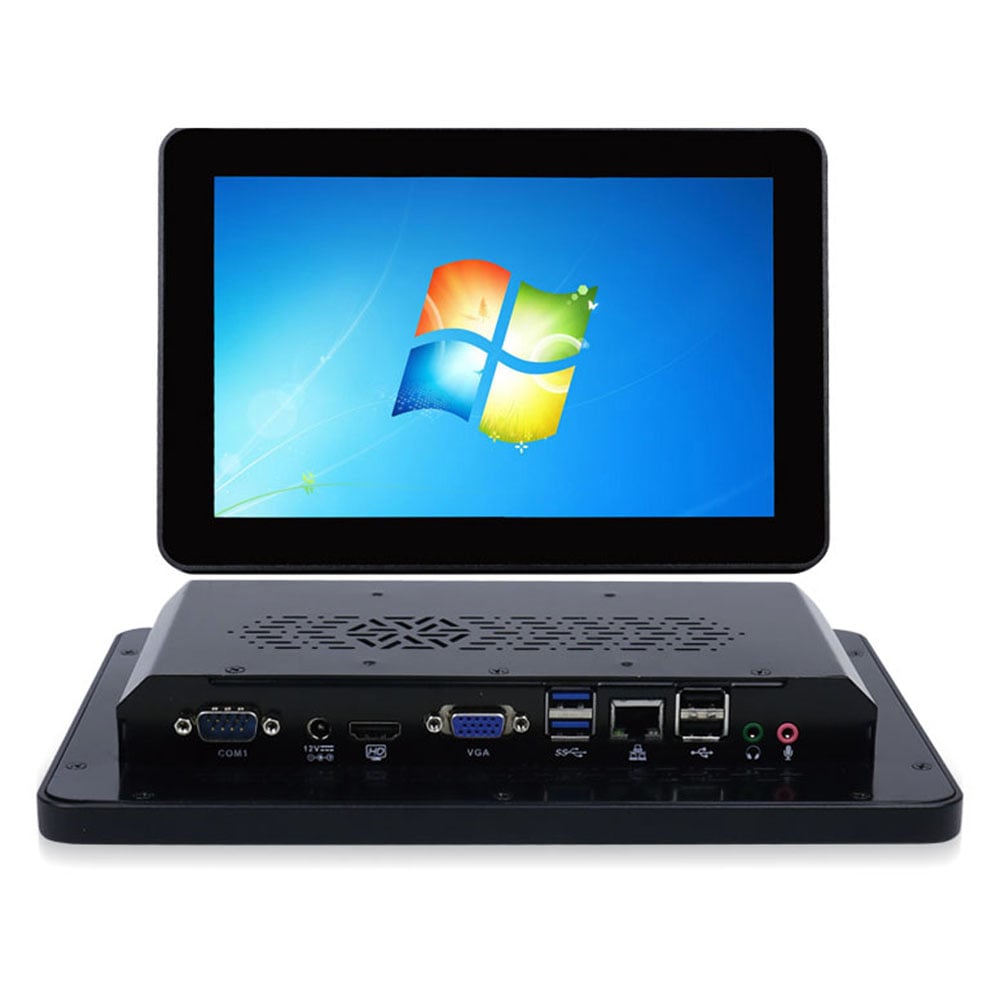
Beyond the Marketing Specs: What Actually Matters
The industrial PC market is on a steady growth trajectory, with projections showing an increase from USD 5.49 billion in 2025 to USD 5.87 billion in 2026, reaching USD 8.44 billion by 2031 at a CAGR of 7.53%. That kind of growth attracts every vendor with a ruggedized chassis and a data sheet. But for the engineers and operations managers who actually have to keep production lines running, the marketing claims matter far less than what happens when the system is bolted into a cabinet on a shop floor.
Evaluating industrial PCs for manufacturing isn't about comparing clock speeds or core counts in isolation. It's about understanding the environment where the hardware will live, the failure modes that actually occur, and the total cost of keeping the system operational over a five-to-ten-year horizon. The right IPC for a clean, climate-controlled assembly line looks very different from the right IPC for a foundry or an outdoor substation.
The Reliability Question: Fanless vs. Fan-Cooled
One of the first decisions in any IPC evaluation is cooling architecture. The numbers are stark. A fan-equipped industrial PC typically has a Mean Time Between Failures (MTBF) of around 10,000 hours. A fanless design, by contrast, can achieve MTBF ratings of 37,000 to 50,000 hours—three to five times higher. Some ruggedized fanless systems certified to MIL-STD-810H push that figure even further.
The reason isn't mysterious. Fans are mechanical components with bearings that wear out, blades that collect dust, and motors that fail. In manufacturing environments where airborne particulate matter is a fact of life, a fan is essentially a vacuum cleaner pulling contaminants directly into the chassis. Fanless designs use passive cooling through strategically placed heatsinks and chassis fins, eliminating the single most common point of failure in industrial computing.
That doesn't mean fan-cooled IPCs are never the right choice. Applications with sustained, high-intensity compute loads may benefit from active cooling's superior thermal transfer. But for 24/7 operation in dusty, vibration-prone environments, the reliability advantage of fanless architecture is difficult to overstate.
Form Factors and Physical Realities
| Form Factor | Best Use Case | Key Trade-off |
|---|---|---|
| Panel PC | HMI, operator interfaces | Limited internal expansion |
| Box PC | Machine vision, edge compute | Moderate I/O flexibility |
| Rackmount | Centralized control rooms | Requires rack infrastructure |
| DIN-rail | Tight spaces, distributed control | Lower compute capacity |
Manufacturing environments demand more than just processing power. The physical format of an IPC determines where it can be deployed, how it interfaces with other equipment, and how easily it can be serviced.
Panel PCs integrate display and compute in a single unit, making them natural choices for human-machine interface stations. The front panel often carries IP65 or higher ingress protection, resisting dust and low-pressure water jets. Box PCs offer more flexibility, with multiple mounting options and a wider range of I/O configurations. Rackmount IPCs pack higher compute density into standardized enclosures but require the supporting rack infrastructure. DIN-rail mount systems excel in control cabinets where space is at a premium.
The choice isn't always obvious. A machine vision application might seem like a natural fit for a box PC, but if the camera needs to be within a few meters of the processing unit and the environment involves coolant mist, a panel PC with sealed front panel might actually be the better answer. The physical constraints of the deployment site often dictate the form factor more than the compute requirements do.
A Real-World Case: The Foundry Floor Upgrade
A tier-one automotive supplier ran a pilot program at a Midwest foundry about two years ago. The existing control systems were built around commercial-grade tower PCs in filtered enclosures. Filter changes were required every two weeks. Despite that, dust ingress still caused an average of three failures per production line per year, each costing roughly four hours of downtime.
The evaluation team tested four different IPC architectures over a six-month period. The winner wasn't the one with the highest clock speed or the most cores. It was a fanless box PC with an IP65-rated enclosure and an operating temperature range that matched the foundry's ambient conditions. After deployment, filter changes dropped from bi-weekly to quarterly. Failures per line fell to less than one per year. The project paid for itself in reduced maintenance labor and avoided downtime within the first eight months.
That outcome wasn't about having the fastest processor. It was about matching the hardware to the environment. The same PC that thrived in the foundry would have been overkill for a cleanroom assembly line, where a fan-cooled unit with higher performance per dollar might have been the more economical choice.
Environmental Ratings: Reading Between the Lines
IP ratings, temperature ranges, and vibration specifications are the language of IPC evaluation, but they require careful interpretation. An IP65-rated front panel protects against dust ingress and low-pressure water jets. IP67 extends that to temporary immersion. IP69K handles high-pressure, high-temperature washdown—relevant for food and beverage production but overkill for most general manufacturing.
Temperature specifications tell a similar story. A system rated for 0°C to 50°C might be perfectly adequate for a climate-controlled factory but completely unsuitable for an unheated warehouse in a northern climate. Extended temperature ranges of -20°C to 60°C or -40°C to 70°C are available, but they come with trade-offs in component selection and cost.
Vibration resistance is another critical parameter. Commercial PCs typically handle about 0.5 G of vibration. Industrial systems rated to IEC 60068-2-64 can withstand 3 to 5 G RMS. In applications near stamping presses, forging hammers, or heavy machinery, that difference determines whether the system stays operational or fails within weeks.
The Connectivity and Expansion Equation
Modern manufacturing isn't isolated. IPCs need to talk to programmable logic controllers, supervisory systems, cloud platforms, and increasingly, edge AI inference engines. The I/O portfolio matters as much as the processor.
A typical industrial box PC might offer multiple serial ports (RS-232/422/485), USB, Gigabit Ethernet, and GPIO for direct machine interfacing. More advanced units add 2.5G or 10G Ethernet, M.2 slots for wireless modules, and PCIe expansion for specialized cards. The key is matching the I/O capability to the specific application without paying for unused capacity.
Edge AI is reshaping these requirements. On-device inference eliminates the latency and reliability concerns of cloud-dependent analytics. IPCs that can host GPU accelerators or AI-specific processors are increasingly common, but they also generate more heat and consume more power—trade-offs that circle back to the cooling architecture decision.
Total Cost of Ownership Over the Long Haul
The purchase price of an IPC is rarely the dominant cost over its service life. Maintenance labor, spare parts inventory, downtime costs, and the engineering time required for replacement and reconfiguration typically dwarf the initial hardware expenditure.
A fanless IPC with a 50,000-hour MTBF and a 15-year lifecycle alignment with manufacturing equipment might cost more upfront than a fan-cooled alternative. But over a decade of operation, the fanless system's reduced maintenance requirements and lower failure rate often produce a lower total cost of ownership. The math changes if the application has low utilization or if the environment is clean and climate-controlled—but for harsh, continuous-operation scenarios, the premium for ruggedization pays for itself.
The same principle applies to expansion capability. A chassis with available PCIe slots and multiple storage bays can accommodate future requirements without replacement. A fixed-configuration system might save money today but require a full hardware refresh when the application evolves.
XSK manufactures industrial PCs across multiple form factors, with an emphasis on fanless thermal design, wide-temperature operation, and I/O configurability. The company's approach to IPC engineering prioritizes long-term reliability in demanding environments—a focus that becomes evident when systems are deployed in production settings where downtime carries a tangible cost.
Table of Contents
- Beyond the Marketing Specs: What Actually Matters
- The Reliability Question: Fanless vs. Fan-Cooled
- Form Factors and Physical Realities
- A Real-World Case: The Foundry Floor Upgrade
- Environmental Ratings: Reading Between the Lines
- The Connectivity and Expansion Equation
- Total Cost of Ownership Over the Long Haul